
AI’s deployment test: useful workflows, water and cash
Excel’s COPILOT function retires today. MSFT and AMZN watch-only; MRVL pass. Friday data, open repricing required.
MONDAY · SEPTEMBER 14, 2026
Morning research updated at 07:50 Toronto. Prices: September 11 completed session; all dollars USD.
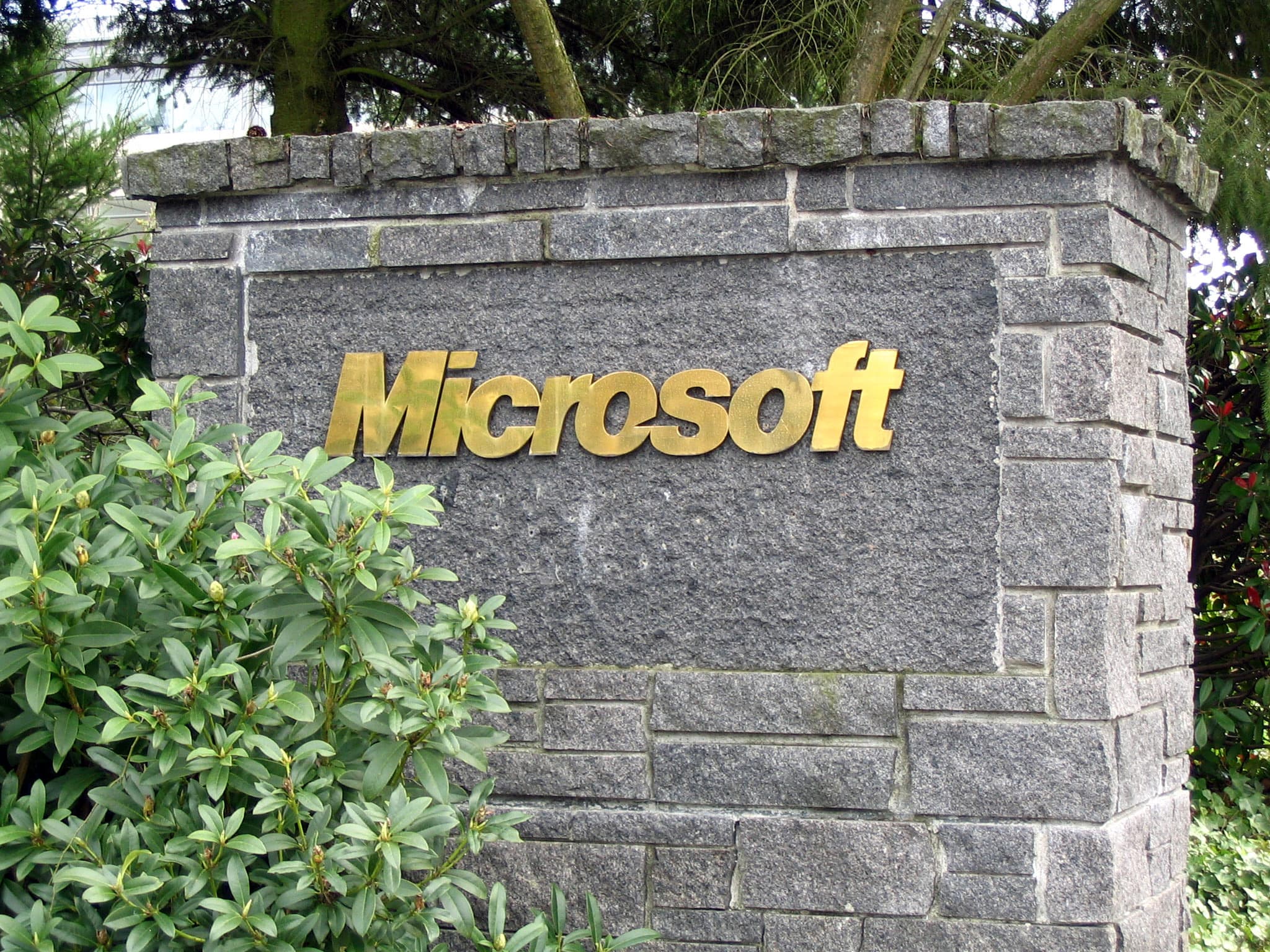
Photo: Microsoft’s Redmond campus sign, April 2005. Historical context, not a 2026 launch image. [9]
The morning brief
- Deployment beats demo count. Microsoft’s COPILOT worksheet function retires today; Copilot in Excel continues. Evaluate the workflow customers keep using, not the number of AI features announced. [1]
- Growth still needs funding. Cloud demand supports Microsoft and Amazon, while their cash investment burdens differ. Our comparison uses the same June quarter, not mismatched annual periods. [2–3]
- Three studies, no rush. MSFT and AMZN are conditional watch-only candidates; MRVL is a pass. Friday’s options snapshots need open repricing, especially ahead of Wednesday’s Fed decision. [7,13–18]
The lead · An AI feature disappears; the adoption test remains
Microsoft’s support notice says the COPILOT worksheet function becomes unavailable starting September 14. The broader Copilot in Excel product remains available. The distinction matters: withdrawing one experimental interface does not establish that an entire AI business has failed. Nor does keeping the wider product prove that every customer earns an adequate return. Today’s concrete change is at the workflow level. [1]
Our interpretation: enterprise AI should be judged by repeatable work completed, the cost of checking its output and the effort required to maintain it. A team that embeds an experimental feature in a recurring spreadsheet may incur migration and validation costs when the interface changes. Those costs belong in the adoption calculation alongside the subscription bill. A successful demonstration says little about whether a process remains dependable over several reporting cycles.
The counterargument is constructive: consolidating interfaces can reduce confusion and make support easier. A narrower, more stable product could attract wider use. The investment question is therefore whether paid customers retain and expand useful workloads after changes, rather than whether a particular button survives. Watch disclosed retention, paid adoption and operating economics before extrapolating a feature announcement into a revenue forecast. That discipline also matters when deciding which shares would be acceptable after put assignment.
Eddie’s watchlist radar
- MSFT · Product durability meets funding capacity. Today’s worksheet change makes renewal quality a useful question. The latest reported June-quarter operating margin was 45.1%, calculated from operating income and revenue. Next: evidence of durable paid usage, then the next earnings date once announced. [1–2]
- AMZN · Distribution expands. Amazon Quick’s desktop app has been generally available since the September 9 article update. Watch whether easier access turns into sustained paid use. AWS’s June-quarter margin was 39.4%; that segment figure is not Amazon’s consolidated margin. [3,12]
- MRVL · Growth faces a valuation hurdle. Fiscal Q2 revenue was $2.739 billion, up 37% year over year; GAAP gross margin was 53.1%. These are August 27 results, not a fresh earnings release. Next: this week’s infrastructure demonstrations and October 6 investor day. [4,6]
AI buildout & revolution
Water is a local operating constraint. Amazon’s September 11 update describes a Pune conservation project with FluxGen, targeting an estimated 178 million liters of annual replenishment after completion by year-end. This is a company projection at a research campus, not measured savings already delivered or proof that a particular data center has adequate water. Our lens: check location, completion and actual flows before treating a sustainability target as operating capacity. [5]
Moving data is part of useful compute. Marvell plans to demonstrate connectivity and memory products at AI Infra Summit, September 15–17 in Santa Clara. Our lens: accelerators waiting for memory or network traffic can turn expensive capacity into idle capacity. Ask for comparable workload tests, power use and deployment costs; a vendor presentation does not establish customer savings or a purchase order. [6]
One comparison · Cash left after equipment investment
June 2026 quarter · operating cash less cash equipment spending
Zero baseline. Microsoft: 55.441 − 35.802 = 19.639. Amazon: 45.387 − (54.208 − 1.132) = −7.689. Amazon equipment spending is net of sale proceeds/incentives.
Source: Microsoft and Amazon June-quarter cash-flow statements [2–3]; calculations by YieldCove.
This comparison isolates the cash equipment burden in the same three-month period. It excludes acquisitions and does not capture all lease commitments, so it is not a complete measure of financing needs. The useful next test is whether the installed capacity produces enough durable cash to justify its cost.
3 Wheel Trade Ideas
Read the evidence first. These are conditional standard 100-share cash-secured-put studies, not orders. Bid-based credits assume no fill and exclude fees/taxes. Friday, September 11 is the last completed U.S. session. Cboe’s delayed snapshots omit exact bid/ask timestamps and open-interest reference dates; last-trade times are not quote times. Reprice and verify deliverables at the September 14 open, or against the live session if reading later. [8,13–18]
Indicators use 501 daily dividend/split-adjusted Yahoo closes through September 11: Wilder RSI(14), arithmetic SMA20/50/200, and completed-session volume divided by the prior 20-session mean. RSI measures momentum, not rebound certainty; averages are reference zones, not guaranteed support. Delta is signed contract sensitivity, not assignment probability. IV rank/percentile are unavailable. Earnings and future ex-dividend dates remain unconfirmed; Wednesday’s Fed decision falls before all three expiries. [7,10–11,13–18]
MSFT · Microsoft
Conditional · watch only
The setup: sell the $470 put, expiring 2026-10-16. One contract means agreeing to buy 100 shares at that price if assigned. 32 calendar days from September 14; dated study only.
Cash to reserve
$47,000
Indicative premium · at bid
$505
Breakeven/share · at expiry
$464.95
Maximum loss · stock at zero
$46,495
- Why own the shares: FY2026 EPS $17.95 implies 25.9× earnings at the $464.95 study entry. June cash/investments $76.843bn versus $40.294bn debt; cash generation supports resilience, not immunity to rate-driven multiple compression. [2]
- Trend and levels: Friday $495.63; RSI 56.9; SMA20/50/200 $494.25/$453.12/$429.65; relative volume 0.68×. Above all averages; $494 is a nearby reference, $499 Friday-high resistance. Thin volume weakens confirmation. [13]
- Contract quality: 470 put: bid/ask $5.05/$5.30, spread $0.25; volume/OI 444/4,922; delta −0.2238, IV 25.31%. Last trade September 11, 15:59:59 (provider time; timezone unspecified). [14]
What if… at expiration?
One standard put, USD before fees/taxes. Scenarios, not forecasts. Zero baseline; maximum loss shown above. Early assignment possible.
Source: Cboe MSFT [14]; YieldCove calculations.
Wait / what changes the thesis
Wait for open repricing and a hold of the near-term average. Next earnings unannounced; August 20 ex-date/September 10 payment already passed. A break toward $453 weakens the setup; a gap can bypass any exit threshold. [10]
AMZN · Amazon
Conditional · watch only
The setup: sell the $240 put, expiring 2026-10-16. One contract means agreeing to buy 100 shares at that price if assigned. 32 calendar days from September 14; dated study only.
Cash to reserve
$24,000
Indicative premium · at bid
$300
Breakeven/share · at expiry
$237
Maximum loss · stock at zero
$23,700
- Why own the shares: AWS cash potential must offset investment. June cash/securities $122.988bn versus $128.894bn long-term debt. Study entry $237 equals 3.3× TTM sales per share using June shares; sales are not earnings and quarterly investment gains distort EPS. [3]
- Trend and levels: Friday $256.78; RSI 48.9; SMA20/50/200 $258.96/$255.25/$239.80; volume 0.83×. Between short averages: $255 reference, $259 resistance; no oversold signal or confirmed breakout. [15]
- Contract quality: 240 put: bid/ask $3.00/$3.15, spread $0.15; volume/OI 2,127/20,747; delta −0.2138, IV 30.73%. Last trade September 11, 15:58:14 (provider time; timezone unspecified). [16]
What if… at expiration?
One standard put, USD before fees/taxes. Scenarios, not forecasts. Zero baseline; maximum loss shown above. Early assignment possible.
Source: Cboe AMZN [16]; YieldCove calculations.
Wait / what changes the thesis
Reconsider only after open repricing and recovery above $259, with acceptable assignment size. Continued cash burn or a loss of $255 weakens the case. Next earnings and ex-dividend schedule not confirmed; do not infer an event-free expiry.
MRVL · Marvell
Pass · revalidate price and valuation
The setup: sell the $200 put, expiring 2026-10-16. One contract means agreeing to buy 100 shares at that price if assigned. 32 calendar days from September 14; dated study only.
Cash to reserve
$20,000
Indicative premium · at bid
$465
Breakeven/share · at expiry
$195.35
Maximum loss · stock at zero
$19,535
- Why own the shares: Q2 operating cash $605.5m less $126.7m equipment = $478.8m. Cash $3.933bn trails long-term debt $4.963bn. Entry $195.35 is 52.0× four times quarterly non-GAAP EPS $0.94: a crude screen, not forward P/E or a margin of safety. [4]
- Trend and levels: Friday $236.10; RSI 55.5; SMA20/50/200 $227.75/$216.84/$154.76; volume 0.71×. Friday’s trend was above all averages; $228/$217 references and $240 resistance require fresh price confirmation. [17]
- Contract quality: 200 put: bid/ask $4.65/$4.90, spread $0.25; volume/OI 910/7,567; delta −0.1718, IV 64.61%. Last trade September 11, 15:59:59 (provider time; timezone unspecified). High IV signals risk. [18]
What if… at expiration?
One standard put, USD before fees/taxes. Scenarios, not forecasts. Zero baseline; maximum loss shown above. Early assignment possible.
Source: Cboe MRVL [18]; YieldCove calculations.
Wait / what changes the thesis
Delayed underlying fields conflict with Friday’s close; no actionable price conclusion. Pass until live quotes, earnings/dividend dates and valuation are verified. October 6 investor day precedes expiry; demand or margin disappointment could overwhelm the premium. [4,11]
Next on the radar
- September 14 · U.S. open, 09:30 Toronto: recheck company news, stock prices and all three option chains; discard stale economics.
- September 15–17 · Santa Clara, America/Los_Angeles: AI Infra Summit; seek comparable performance evidence, not demonstration headlines. Exact session times vary. [6]
- September 16 · 14:00 Toronto: Fed decision; press conference 14:30. Ask how financing costs change acceptable assignment prices; no policy outcome is assumed. [7]
From YieldCove
Use the public wheel calculator to separate cash reserved, premium and downside before recording a scenario. Three AI-linked companies share sector risk; a watchlist is not a portfolio, and these cards do not imply ownership.
Risk & editorial disclosures
Educational market commentary, not personalized investment advice. Options involve risk, including early assignment and loss of the cash committed less premium. AI-assisted research and drafting; sources and calculations were counter-checked, but errors remain possible. Independently verify before any decision.
Sources
- [1]Excel COPILOT function retirement — Microsoft · Accessed 2026-09-14T11:53:09.828040+00:00 · Tier 1
- [2]Microsoft FY2026 Q4 results — Microsoft IR · Accessed 2026-09-14T11:53:09.828040+00:00 · Tier 1
- [3]Amazon Q2 2026 results — Amazon IR · Accessed 2026-09-14T11:53:09.828040+00:00 · Tier 1
- [4]Marvell FY2027 Q2 results — Marvell IR · Accessed 2026-09-14T11:53:09.828040+00:00 · Tier 1
- [5]Amazon water project update · September 11 — Amazon · Accessed 2026-09-14T11:53:09.828040+00:00 · Tier 1
- [6]Marvell AI Infra Summit · September 9 — Marvell IR · Accessed 2026-09-14T11:53:09.828040+00:00 · Tier 1
- [7]Federal Reserve September calendar — Federal Reserve · Accessed 2026-09-14T11:53:09.828040+00:00 · Tier 1
- [8]OIC cash-secured put — Options Industry Council · Accessed 2026-09-14T11:53:09.828040+00:00 · Tier 1
- [9]Microsoft campus photograph · April 2005 — Wikimedia Commons / Derrick Coetzee · Accessed 2026-09-14T11:53:09.828040+00:00 · Tier 1
- [10]Microsoft dividend declaration — Microsoft · Accessed 2026-09-14T11:53:09.828040+00:00 · Tier 1
- [11]Marvell dividend declaration — Marvell IR · Accessed 2026-09-14T11:53:09.828040+00:00 · Tier 1
- [12]Amazon Quick desktop · article update September 9 — Amazon · Accessed 2026-09-14T11:53:09.828040+00:00 · Tier 1
- [13]MSFT · daily history — Yahoo Finance · Accessed 2026-09-14T11:53:09.828040+00:00 · Tier 2
- [14]MSFT · delayed options — Cboe · Accessed 2026-09-14T11:53:09.828040+00:00 · Tier 1
- [15]AMZN · daily history — Yahoo Finance · Accessed 2026-09-14T11:53:09.828040+00:00 · Tier 2
- [16]AMZN · delayed options — Cboe · Accessed 2026-09-14T11:53:09.828040+00:00 · Tier 1
- [17]MRVL · daily history — Yahoo Finance · Accessed 2026-09-14T11:53:09.828040+00:00 · Tier 2
- [18]MRVL · delayed options — Cboe · Accessed 2026-09-14T11:53:09.828040+00:00 · Tier 1
This content is for informational and educational purposes only and is not financial advice. Options involve risk and are not suitable for every investor. Do your own research before trading.
The free YieldCove newsletter
Get The Wheelhouse in your inbox
Three briefings a week — market context, practical wheel-strategy ideas and YieldCove updates. Free to read. Unsubscribe anytime.
Educational only — not financial advice.