
AI’s power test: useful work, cash and three wheel decisions
A fixed-power test, AWS workflow deals and the Fed. EN first, français ensuite.
WEDNESDAY · SEPTEMBER 16, 2026 Before the U.S. open; September 15 closing data, USD throughout. Today’s Fed decision is scheduled for 14:00 Toronto, followed by the 14:30 press conference. No policy outcome is assumed. [1]
The morning brief
- Power becomes a production variable. Nvidia’s latest infrastructure update focuses on useful output within a fixed electricity budget; benchmark conditions matter as much as the headline. [2–3]
- Distribution meets workflow. AWS and Salesforce are connecting enterprise data and agents; Microsoft raised its quarterly dividend. These are different signals, not interchangeable evidence of AI profits. [4,6]
- Three studies, no rush. AMZN and MSFT remain watch-only; ORCL is a pass for now. The Fed and dated option quotes make patience part of the analysis.
The lead · More useful work from the same power
Nvidia’s September 15 infrastructure update brings the AI spending debate down to a practical constraint: what can an operator produce from electricity already available? The company reports that Lambda tested DSX MaxLPS on HGX B200 equipment, running 19 nodes within the power budget of 16 full-power nodes. Reported token throughput rose 24%; performance per watt rose 23%. These are disclosed deployment-test results, not a universal promise for every data center. [2]
Our interpretation: better utilization could let cloud operators serve more paid work before adding an entire new facility. That matters to investors because the economic benefit depends on three separate steps: achieving the efficiency, finding customers for the extra capacity, and retaining enough pricing power to keep the savings. More tokens alone do not establish higher free cash flow.
The counterargument is straightforward. Customers may capture much of the benefit through lower prices, or use cheaper inference to run far more work. Either path can increase usage without improving the operator’s return on invested capital. Compare like workloads, latency and quality; then ask whether utilization and cash generation improve. Today’s rate decision adds another uncertainty to long-lived infrastructure investment. A technical improvement is useful evidence, but it does not remove financing, execution or demand risk.
Eddie’s watchlist radar
- AMZN · Reach customers where they work. The September 15 Salesforce collaboration connects CRM context to Amazon Quick and brings AWS agents into Slack, beginning with DevOps. Next: actual adoption, paid usage and integration reliability—not a revenue estimate inferred from a launch. [4]
- MSFT · A new cash commitment. Tuesday’s declaration raises the quarterly dividend from $0.91 to $0.98. The ex-date is November 19 and payment December 10. Next: whether cash generation can comfortably support both distributions and infrastructure investment. [6]
- ORCL · Backlog is not cash. Last week’s release reported $664bn of remaining performance obligations and negative $5bn quarterly free cash flow. There is no fresh earnings release today in this evidence set. Next: conversion of commitments into service and collected cash. [9]
AI buildout & revolution
Autonomous engineering needs accountable deployment. Cognition and AWS announced a multiyear agreement on September 15. Devin is available through AWS Marketplace; the release describes dedicated customer environments and engineers reviewing output. Deeper integrations remain exploratory. Our lens: migration and maintenance can create cloud consumption, but vendor case studies do not establish typical savings. Track accepted changes, rollback rates, review time and total operating cost. [5]
The system around the chip matters. Nvidia’s summit update says Amazon’s Annapurna Labs is working with Nvidia on NVHBM memory technology, while d-Matrix is integrating with NVLink Fusion. These are collaborations, not disclosed revenue awards. Our lens: memory, interconnect and software can constrain useful throughput even when peak compute looks abundant. Component announcements deserve follow-up on availability, customer qualification and cost, rather than an automatic upward revision to every supplier’s sales. [3]
One comparison · A fixed-power throughput test
Lambda token throughput · baseline = 100
HGX B200 deployment test: 16 full-power nodes versus 19 managed nodes under the same power budget. Zero baseline; not a revenue forecast.
Source: NVIDIA, September 15; reported +24%, normalized by YieldCove. [2]
Normalization makes the comparison readable without claiming false precision from rounded tokens-per-second figures: 100 × 1.24 = 124. The separate 23% performance-per-watt figure uses its own reported metric; do not silently replace one with the other. Neither measure says what customers will pay, how often the cluster is busy, or how much depreciation its owner must absorb. For investment analysis, those missing links are the next questions, not details to fill with assumptions. [2]
3 Wheel Trade Ideas
Dated studies, not executable offers. All three are October 16 puts: 30 calendar days from this edition. A standard contract means 100 shares; confirm the broker’s deliverable. Bid-based credits assume no fill and exclude fees/taxes. Cboe snapshots were retrieved September 16 before the open; contract last trades are September 15, but precise bid/ask timestamps, timezone and open-interest dates are unavailable. Reprice after the open and after the Fed; no current return is promised. [10,13,15,17]
Technicals use 501 adjusted daily Yahoo closes through September 15: Wilder RSI(14), SMA20/50/200 and completed-session volume divided by the prior 20 sessions’ mean. RSI is not rebound certainty; signed delta is sensitivity, not assignment probability. IV rank/percentile and confirmed next earnings dates are unavailable. Early assignment remains possible; technical levels cannot guarantee exits. These are watchlist names, not assumed holdings. [10,12–17]
AMZN · Amazon
Watch only · wait for the Fed · The setup: sell the $230 put, expiring 2026-10-16. One contract means agreeing to buy 100 shares at that price if assigned. Historical standard-contract scenario only.
Cash to reserve
$23,000
Indicative premium · at bid
$248
Breakeven/share · at expiry
$227.52
Maximum loss · stock at zero
$22,752
- Why own the shares: AWS monetization is attractive, but June TTM free cash flow was −$7.60bn. Cash/securities $122.99bn versus long-term debt $128.89bn; AWS margin 39.4%. Study entry $227.52 is 3.16× TTM sales using June shares, not a fair-value estimate. [8]
- Trend and levels: Tuesday $248.42; RSI 41.4; SMA20/50/200 $257.86/$255.56/$240.03; volume 1.12×. Below short averages; $240 is a support reference, $256–258 a recovery zone. [12]
- Contract quality: 230 put: bid/ask $2.48/$2.60; spread $0.12; volume/OI 1,041/10,530; delta −0.1878; IV 32.86%. Last trade September 15, 15:59:42, timezone unspecified. [13]
What if… at expiration?
One-put P&L, before fees/taxes. Scenarios, not forecasts. Shared zero baseline; the chart does not show maximum loss. Early assignment is possible.
Source: Cboe delayed bid; YieldCove calculations. [13]
Wait / what changes the thesis
Wait for fresh post-Fed quotes and stabilization above the $240 area; a break weakens this setup. Negative cash flow limits comfort at the lower entry. Next earnings and dividend status remain unconfirmed; check both before any order.
MSFT · Microsoft
Watch only · confirm support · The setup: sell the $470 put, expiring 2026-10-16. One contract means agreeing to buy 100 shares at that price if assigned. Historical standard-contract scenario only.
Cash to reserve
$47,000
Indicative premium · at bid
$500
Breakeven/share · at expiry
$465
Maximum loss · stock at zero
$46,500
- Why own the shares: Cloud/software support ownership research. June-quarter operating margin 45.1%, cash flow less cash capex $19.64bn; cash/investments $76.84bn versus debt $40.29bn. Entry $465 is 25.9× FY2026 GAAP EPS, which includes investment gains. This is not a forecast multiple. [7]
- Trend and levels: Tuesday $497.12; RSI 56.0; SMA20/50/200 $495.68/$457.65/$429.94; volume 0.84×. Above the averages, barely above SMA20. $496 is the first reference, $505 a recovery checkpoint. [14]
- Contract quality: 470 put: bid/ask $5.00/$5.20; spread $0.20; volume/OI 372/5,811; delta −0.2175; IV 27.42%. Last trade September 15, 15:59:23, timezone unspecified. [15]
What if… at expiration?
One-put P&L, before fees/taxes. Scenarios, not forecasts. Shared zero baseline; the chart does not show maximum loss. Early assignment is possible.
Source: Cboe delayed bid; YieldCove calculations. [15]
Wait / what changes the thesis
Reprice after the Fed; losing SMA20 warrants patience rather than treating premium as protection. The November 19 ex-date is after expiry. Confirm earnings; slower cloud growth or persistently heavier spending would undermine ownership. [6]
ORCL · Oracle
Pass · financing and trend concerns · The setup: sell the $125 put, expiring 2026-10-16. One contract means agreeing to buy 100 shares at that price if assigned. Historical standard-contract scenario only.
Cash to reserve
$12,500
Indicative premium · at bid
$235
Breakeven/share · at expiry
$122.65
Maximum loss · stock at zero
$12,265
- Why own the shares: AI cloud demand is real in reported sales, but Q1 free cash flow was −$5bn despite $23bn operating cash flow; equity issuance raised $20bn before commissions. Entry $122.65 is 15.1× management’s $8.10 FY2027 non-GAAP EPS guide, not realized earnings. [9]
- Trend and levels: Tuesday $140.35; RSI 43.0; SMA20/50/200 $148.78/$140.67/$166.28; volume 1.13×. Below all three averages; $140 is a fragile reference and $149 a recovery checkpoint. [16]
- Contract quality: 125 put: bid/ask $2.35/$2.44; spread $0.09; volume/OI 390/8,024; delta −0.1958; IV 50.69%. Last trade September 15, 15:59:18, timezone unspecified. [17]
What if… at expiration?
One-put P&L, before fees/taxes. Scenarios, not forecasts. Shared zero baseline; the chart does not show maximum loss. Early assignment is possible.
Source: Cboe delayed bid; YieldCove calculations. [17]
Wait / what changes the thesis
Pass until post-Fed trend recovery and a complete debt/lease review; the current release does not clear that balance-sheet test. Dividend record October 9/payment October 23; exchange ex-date and next earnings unconfirmed. Higher IV signals risk, not safety. [9]
Next on the radar
- September 16 · 14:00/14:30 Toronto. Fed decision and press conference: how does the policy path change financing assumptions? [1]
- September 17 · 09:30 Toronto. Our next-session checkpoint, not a scheduled company announcement: do cloud shares retain their post-Fed move when normal options trading resumes?
- October 9 · U.S. record date. Oracle’s declared dividend record precedes our October 16 studies. Verify the exchange ex-date separately; a record date is not proof of an executable dividend strategy. [9]
From YieldCove
Use the wheel calculator to compare cash committed, premium and downside before judging an idea by yield. Record the ownership thesis first. Three cloud-linked names can still fall together; separate tickers do not guarantee diversification.
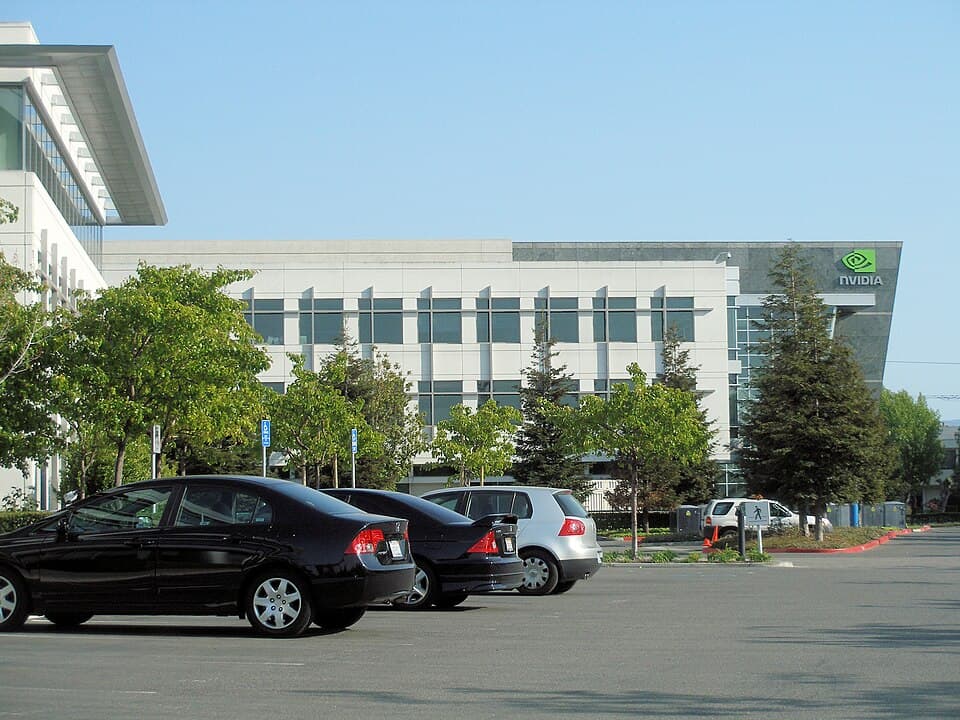
Photo: Nvidia headquarters in Santa Clara, photographed April 19, 2008. Historical company context; not the Eos facility or today’s summit. Coolcaesar / Wikimedia Commons, CC BY-SA 3.0, resized thumbnail, no crop. [11]
Sources
- [1]Fed September calendar — Federal Reserve · Accessed 2026-09-16 · Tier 1
- [2]Power and throughput · September 15 — NVIDIA · Accessed 2026-09-16 · Tier 1
- [3]AI Infra Summit · September 15 — NVIDIA · Accessed 2026-09-16 · Tier 1
- [4]AWS + Salesforce · September 15 — AWS · Accessed 2026-09-16 · Tier 1
- [5]Cognition collaboration · September 15 — AWS · Accessed 2026-09-16 · Tier 1
- [6]Dividend increase · September 15 — Microsoft · Accessed 2026-09-16 · Tier 1
- [7]FY2026 Q4 financial statements — Microsoft IR · Accessed 2026-09-16 · Tier 1
- [8]Q2 2026 financial statements — Amazon IR · Accessed 2026-09-16 · Tier 1
- [9]FY2027 Q1 results · September 10 — Oracle · Accessed 2026-09-16 · Tier 1
- [10]Cash-secured put mechanics — OIC · Accessed 2026-09-16 · Tier 1
- [11]Nvidia headquarters · April 19, 2008 — Coolcaesar / Wikimedia Commons · Accessed 2026-09-16 · Tier 1
- [12]AMZN daily prices · September 15 — Yahoo Finance · Accessed 2026-09-16 · Tier 2
- [13]AMZN delayed option study — Cboe · Accessed 2026-09-16 · Tier 1
- [14]MSFT daily prices · September 15 — Yahoo Finance · Accessed 2026-09-16 · Tier 2
- [15]MSFT delayed option study — Cboe · Accessed 2026-09-16 · Tier 1
- [16]ORCL daily prices · September 15 — Yahoo Finance · Accessed 2026-09-16 · Tier 2
- [17]ORCL delayed option study — Cboe · Accessed 2026-09-16 · Tier 1
AI-assisted research and translation, checked by Codex against linked sources. Vendor statements and conditional interpretations are identified; independent editorial review is required before subscriber delivery.
This content is for informational and educational purposes only and is not financial advice. Options involve risk and are not suitable for every investor. Do your own research before trading.
The free YieldCove newsletter
Get The Wheelhouse in your inbox
Three briefings a week — market context, practical wheel-strategy ideas and YieldCove updates. Free to read. Unsubscribe anytime.
Educational only — not financial advice.