
Weekend brief · October 3
- Tesla’s physical business: Friday’s delivery update gives us operating volumes. It leaves the bigger question—what those volumes earn—open until financial results. [1]
- AI beyond a demonstration: Google’s Argon rollout and Shopify’s Canvas launch put usefulness, supervision and distribution in focus. Announced capability is not yet a measured return on capital. [4,6]
- Wheel desk: Tesla is a pass; Amazon and Alphabet are watch-only. Three visual studies show the ownership commitment behind a premium, using Friday’s references rather than weekend executable prices.
The lead · deliveries are only the first checkpoint
Tesla reported 486,532 third-quarter vehicle deliveries and 13.7 GWh of storage deployments on October 2. Production was 464,391 vehicles. These are operating quantities; Tesla will report the quarter’s financial results after the October 21 close. [1]
Our interpretation: the useful weekend question is what converts activity into cash. More vehicles on the road can expand the installed base, but investors still need selling prices, costs and the spending required to support the next phase. A delivery headline cannot establish the profitability of autonomous driving or the return on an AI investment.
The distinction matters for a wheel investor. Assignment buys shares in the whole company, including its financing needs and uncertain future projects. The option premium does not separate a mature operating business from the expectations embedded in its share price. Decide which business results would justify ownership before choosing a strike.
The counterargument is that today’s accounts can understate an emerging business’s eventual opportunity. That is plausible, but it makes the thesis more dependent on execution. Our checklist for the next report is cash conversion, capital spending and evidence of repeatable customer economics. Until then, Friday’s volume update is a checkpoint, not a valuation verdict. The historical cash comparison below explains why that distinction deserves attention.
Eddie’s watchlist · three developments to carry forward
- TSLA — the next evidence is financial: deliveries and storage deployments are now known; margins and cash conversion are not. October 21 is the next confirmed reporting checkpoint. The wheel card deliberately passes despite an apparently manageable delta, because ownership quality matters more than the premium. [1,2]
- MU — a strong quarter is not a permanent run rate: Wednesday’s release reported $54.23 billion of fiscal Q4 revenue and $33.20 billion of company-defined adjusted free cash flow. The quarter ended September 3. Our question for coming customer updates is whether memory demand and pricing can sustain returns as supply investment catches up; the reported quarter does not answer that. [5]
- SHOP — agents inside an existing workflow: Shopify announced Canvas on October 1, a store-design workspace built around Sidekick, rolling out over coming days. It is not yet replacing the existing editor. Our next question is whether merchants publish useful changes and keep using it; a product launch alone establishes neither retention nor incremental revenue. [6]
AI buildout & adoption · capability meets the operating bill
1. A frontier rollout with a boundary. Google announced Gemini 4 Argon on September 30 with initial access for trusted cyber defenders through its Fairwind Program. Broader access is planned, not established by that announcement. Its introductory list prices are $2 per million input tokens and $10 per million output tokens. [4]
Our investment lens: measure cost per successfully completed workflow, including retries and human review. A low token price is not that total. Shareholders should ask who keeps the savings—the model provider, software distributor or customer. A benchmark cannot settle this.
2. Follow cash through the cloud. Amazon’s July release reported $42.2 billion of Q2 AWS revenue, while trailing-twelve-month free cash flow was a $7.6 billion outflow. The periods and measures differ deliberately: a growing cloud business can coexist with a large company-wide investment bill. [7]
Our interpretation: suppliers can collect revenue before cloud operators finish building capacity. Neither permanent supplier profits nor operator losses follow automatically. Watch utilization and cash after spending. Do not add supplier revenue and customer investment as separate pools of final demand.
One comparison · a cash gap, not a forecast
Tesla: cash generation versus investment
Quarter ended June 30; not Q3 results.
Source: Tesla, Q2 2026; YieldCove calculations [2].
Text alternative: Tesla generated $4,697 million of operating cash in Q2 and spent $5,789 million on capital expenditure. Subtracting gives negative $1,092 million, or −$1.092 billion. This historical gap does not predict Q3; it shows why production volumes and cash generation require separate checks. [2]
Macro checkpoint: September U.S. payrolls rose 29,000, unemployment was 4.2%, and July/August payrolls were revised down by a combined 60,000. Our read: softer hiring can pressure demand despite hopes of lower rates. The report does not identify AI as the cause. [3]
3 Wheel Trade Ideas
PRIOR-SESSION STUDIES · October 16 puts, 13 calendar days. October 2 stock closes and option last trades. Exact bid/ask clock, timezone, delay, OI date and IV rank are unconfirmed. Markets are closed this weekend; reprice at the October 5 opening. No fill assumed. All amounts USD.
One standard 100-share put; verify deliverables. Cash = strike × 100; reference credit = bid × 100; breakeven = strike − bid. Maximum loss assumes the stock reaches zero, less credit. Delta is a model sensitivity, not an assignment guarantee. Indicators use daily Wilder RSI14, adjusted-close SMAs and full-session volume divided by the preceding 20-session average. [12–17,20]
TSLA · Tesla
Pass · ownership risk outruns the credit · Prior-session study: the $345 put, expiring October 16, 2026. One contract means agreeing to buy 100 shares at that price if assigned. Prior-session reference; not a current offer.
Cash to reserve
$34,500
Reference credit · not current
$222
Breakeven/share · at expiry
$342.78
Maximum loss · stock at zero
$34,278
- Why own the shares: Autos are sensitive to demand and rates; future AI economics remain uncertain. Q2 GAAP EPS was $0.32. Breakeven is 267.8× four times that quarter’s EPS—an unnormalized, investment-gain-affected reference, not a forward P/E. The premium does not make this inexpensive. [2]
- Trend and levels: Close $370.59; RSI 55.0; SMA20/50/200 $364.87/$347.58/$393.18; relative volume 1.43×. Above shorter averages but below the 200-day; not oversold. [12]
- Contract quality: October 2 bid/ask $2.22/$2.34; spread $0.12; delta −0.1539; IV 37.95%; volume 1,456/OI 3,004. Displayed size 9/51; last trade 15:59:55, provider clock. [13]
Reference arithmetic · prior-session study
One-put P&L, before fees/taxes. Scenarios, not forecasts. Shared zero baseline; the chart does not show maximum loss. Early assignment is possible.
Source: Cboe; YieldCove calculations [13].
Wait / what changes the thesis
Reconsider only after fresh quotes and stronger cash/valuation evidence. A sustained break below $347.58 or deteriorating cash conversion invalidates the support thesis. Earnings October 21, after expiry; no regular cash dividend under current policy. Early assignment remains possible. [1,19]
AMZN · Amazon
Watch-only · cloud growth needs cash conversion · Prior-session study: the $240 put, expiring October 16, 2026. One contract means agreeing to buy 100 shares at that price if assigned. Prior-session reference; not a current offer.
Cash to reserve
$24,000
Reference credit · not current
$125
Breakeven/share · at expiry
$238.75
Maximum loss · stock at zero
$23,875
- Why own the shares: AWS offers recurring computing demand, while retail remains exposed to softer employment. Q2 EPS $5.75 included large investment gains; annualizing it would exaggerate recurring earnings. Trailing free cash flow was negative, so no clean cash-flow cheapness case is established. [7]
- Trend and levels: Close $251.52; RSI 48.6; SMA20/50/200 $251.64/$256.54/$241.36; relative volume 0.96×. Below shorter averages, above the 200-day; not oversold. Strike below that long-term reference. [14]
- Contract quality: October 2 bid/ask $1.25/$1.38; spread $0.13; delta −0.1817; IV 27.40%; volume 2,789/OI 23,373. Size 122/92; last trade 15:59:35, provider clock. [15]
Reference arithmetic · prior-session study
One-put P&L, before fees/taxes. Scenarios, not forecasts. Shared zero baseline; the chart does not show maximum loss. Early assignment is possible.
Source: Cboe; YieldCove calculations [15].
Wait / what changes the thesis
Wait for fresh quotes and stabilization above $241.36; reclaiming $256.54 would strengthen the trend case. A sustained loss of the 200-day or weaker cloud economics invalidates it. Next earnings unconfirmed; Amazon reports no cash-dividend history. Recheck both calendars. [18]
GOOGL · Alphabet
Watch-only · distribution, with spending discipline · Prior-session study: the $325 put, expiring October 16, 2026. One contract means agreeing to buy 100 shares at that price if assigned. Prior-session reference; not a current offer.
Cash to reserve
$32,500
Reference credit · not current
$139
Breakeven/share · at expiry
$323.61
Maximum loss · stock at zero
$32,361
- Why own the shares: Search and cloud offer routes to paid AI use; weaker advertising demand is a macro risk. Q2 Cloud operating income was $8.814 billion. GAAP EPS $9.11 included major investment gains, so a low annualized headline multiple would not establish cheapness. [8]
- Trend and levels: Close $343.50; RSI 50.0; SMA20/50/200 $342.62/$344.23/$338.54; relative volume 0.87×. Around the averages, not oversold; strike below the 200-day reference. [16]
- Contract quality: October 2 bid/ask $1.39/$1.57; spread $0.18; delta −0.1487; IV 28.27%; volume 891/OI 7,466. Size 9/67; last trade 15:52:03, provider clock. [17]
Reference arithmetic · prior-session study
One-put P&L, before fees/taxes. Scenarios, not forecasts. Shared zero baseline; the chart does not show maximum loss. Early assignment is possible.
Source: Cboe; YieldCove calculations [17].
Wait / what changes the thesis
Wait for fresh quotes and support above $338.54; a sustained break or weakening AI monetization invalidates the thesis. Next earnings and ex-dividend dates unconfirmed; September’s declared payment is historical, not a new entitlement. The put can still suffer a large loss. [8]
Next on the radar · Toronto time
- October 5, 09:30: next regular U.S. stock/options opening. Reprice all three studies; verify earnings, dividends and deliverables before considering a position.
- October 14, 08:30: September CPI, within all three contracts’ lives. Inflation could change both discount rates and household purchasing power. [9]
- October 21, after close: Tesla Q3 results; Q&A at 17:30. Compare reported cash and margins with the volume update, rather than extrapolating from deliveries. [1]
From YieldCove · write the ownership decision first
In YieldCove, record the ownership thesis and cash required. Covered calls cap upside without erasing stock losses; three technology names still share macro risks.
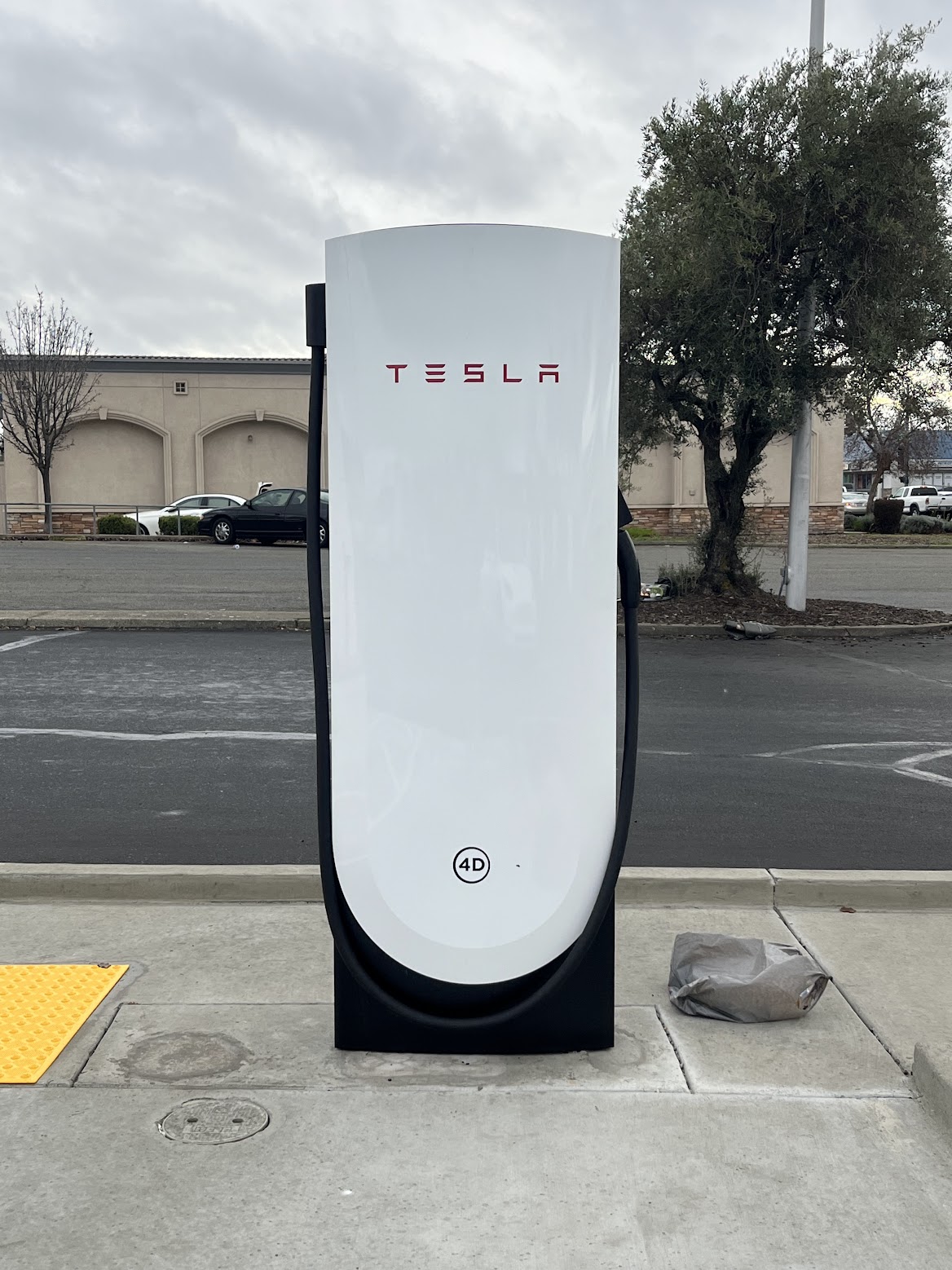
Photo: Tesla V4 charging dispenser, January 10, 2024; historical context, not Q3 2026 activity. Gamesyns, CC BY-SA 4.0; original photograph, unaltered. [10,11]
AI-assisted editorial by Codex. Educational information, not personalized investment advice. Scenarios exclude fees and taxes; early assignment is possible. No trades are executed.
Sources
- [1]Tesla Q3 volumes · October 2 / Volumes T3 · 2 octobre — Tesla · Accessed 2026-10-03 · Tier 1
- [2]Tesla Q2 update · July 22 / T2 · 22 juillet — Tesla · Accessed 2026-10-03 · Tier 1
- [3]September employment · October 2 / Emploi de septembre — BLS · Accessed 2026-10-03 · Tier 1
- [4]Gemini 4 Argon · September 30 / 30 septembre — Google · Accessed 2026-10-03 · Tier 1
- [5]Micron FY26 Q4 · September 30 / T4 exercice 2026 — Micron · Accessed 2026-10-03 · Tier 1
- [6]Canvas launch · October 1 / Lancement du 1er octobre — Shopify · Accessed 2026-10-03 · Tier 1
- [7]Amazon Q2 · July 30 / T2 · 30 juillet — Amazon · Accessed 2026-10-03 · Tier 1
- [8]Alphabet Q2 · July 22 / T2 · 22 juillet — Alphabet / SEC · Accessed 2026-10-03 · Tier 1
- [9]October calendar / Calendrier d’octobre — BLS · Accessed 2026-10-03 · Tier 1
- [10]Tesla V4 · January 10, 2024 / 10 janvier 2024 — Gamesyns / Wikimedia Commons · Accessed 2026-10-03 · Tier 1
- [11]Photo license / Licence photo · CC BY-SA 4.0 — Creative Commons · Accessed 2026-10-03 · Tier 1
- [12]TSLA completed sessions / Séances complètes — Yahoo Finance · Accessed 2026-10-03 · Tier 2
- [13]TSLA October 2 options / Options du 2 octobre — Cboe · Accessed 2026-10-03 · Tier 1
- [14]AMZN completed sessions / Séances complètes — Yahoo Finance · Accessed 2026-10-03 · Tier 2
- [15]AMZN October 2 options / Options du 2 octobre — Cboe · Accessed 2026-10-03 · Tier 1
- [16]GOOGL completed sessions / Séances complètes — Yahoo Finance · Accessed 2026-10-03 · Tier 2
- [17]GOOGL October 2 options / Options du 2 octobre — Cboe · Accessed 2026-10-03 · Tier 1
- [18]Amazon dividend policy / Politique de dividende — Amazon · Accessed 2026-10-03 · Tier 1
- [19]Tesla dividend policy / Politique de dividende — Tesla · Accessed 2026-10-03 · Tier 1
- [20]Cash-secured put mechanics / Put garanti en espèces — OIC · Accessed 2026-10-03 · Tier 1
This content is for informational and educational purposes only and is not financial advice. Options involve risk and are not suitable for every investor. Do your own research before trading.