To roll a cash-secured put, you buy back the put you sold and sell a new put on the same stock with a later expiration, often at a lower strike. Most brokers let you send both legs as one roll order, for a net credit or a net debit. Buying back the old put locks in its gain or loss. The new put is a fresh obligation to buy 100 shares per contract at its strike.
- Confirm the put is still open and not yet assigned.
- Check how much time value the old put has left.
- Choose the new expiration and strike as if it were a new trade.
- Price both legs: new premium minus buy-back cost.
- Check the cash the new strike ties up (strike × 100).
- Send one roll order with a limit price, then confirm both fills.
- Record the buy-back and the new put as separate entries.
In the example below, the roll brings in $50 while buying back the old put locks in a $200 loss. Both numbers are real. Only one of them shows up as a credit on the order ticket.
When rolling makes sense, and when it doesn't
People usually roll a cash-secured put for one of three reasons: the stock has fallen to or below the strike near expiration and they'd rather not buy the shares yet; the stock has rallied and the old put is nearly worthless, so they reset at a higher strike; or most of the premium is already earned and they want the cash working again. Rolling is a choice, not a repair. Answer these first:
- Would you sell the new put today if you had no position? If not, the roll only postpones a decision you don't like.
- Do you still want the shares at the new strike? A cash-secured put can end in assignment no matter how many times it has been rolled.
- Is the credit worth the extra time? $50 for five more weeks is a different trade from $50 for one more week. Compare it with the cash the new strike ties up.
- Is there an event inside the new cycle? An earnings report before the new expiration can gap the stock straight through your strike. Confirm the date on the company's investor-relations site.
- What would make you stop? Decide before the first roll. Rolling down and out again and again for small credits can keep cash tied up for months while the stock keeps falling.
Three ways to roll a put
| Roll | What changes | Usual reason | Trade-off |
|---|---|---|---|
| Out | Same strike, later expiration | Stock near the strike; you want more time | Same purchase price, more days at risk |
| Down and out | Lower strike, later expiration | Stock fell below the strike | Lower purchase price, smaller credit or a debit |
| Up and out | Higher strike, later expiration | Stock rallied; old put nearly worthless | More premium, higher price if assigned |
Rolling down without adding time always costs money: a lower-strike put on the same expiration is worth less than the one you're buying back. That's why the defensive roll is usually down and out. You can price all three in the roll calculator.
1. Confirm what you still hold
Check the symbol, strike, expiration and number of contracts in your account. A standard equity contract covers 100 shares; after a split, merger or special dividend, an adjusted contract can deliver something else, so read the deliverable. If you've already been assigned, there's no put left to roll: you own the shares, and the usual next step in the wheel is a covered call.
2. Check the time value left
A put's price is its intrinsic value (strike minus stock price, when positive) plus its time value. On a same-strike roll the intrinsic value cancels out, so the credit is the new put's time value minus what's left of the old one's. When the old put is deep in the money and its price is almost all intrinsic value, two things happen: early assignment gets more likely, and the credit gets thin.
3. Pick the new expiration and strike
Choose the replacement as if it were a brand-new trade: a strike where you'd be fine owning 100 shares, and an expiration you can live with. A later date buys more premium and more days of exposure. A lower strike lowers the price you'd pay on assignment and brings in less premium.
4. Price both legs
Write down the cost to buy back the old put and the premium for the new one. Roll credit = new premium − buy-back cost, times 100 per contract. A positive number is a net credit, a negative one a net debit. Commissions come off both legs.
5. Check the cash the new put ties up
A cash-secured put needs the full purchase price set aside: a $48 strike means $4,800 per contract. That's not the breakeven, which counts the premium. Brokers apply their own cash and account rules, so check the requirement on the order screen before you send it.
6. Send one roll order and confirm both fills
Most brokers offer a roll or two-leg ticket: buy to close the old put and sell to open the new one, with a limit on the net credit or debit. A limit sets your price; it doesn't guarantee a fill. If you send the legs separately, a filled buy-back with an unfilled sale leaves you with no position, and the reverse order briefly leaves you short two puts. Check both fills before you call it done.
7. Record it as two trades
Close the old put at its buy-back price and log the new put as a new entry, each with its own fill and commission. Netting them into one "adjusted" trade is how a $50 credit ends up hiding a $200 loss. The free wheel spreadsheet works this way (close the old row, add a new one), and the YieldCove tracker links the legs into one roll chain.
Worked example: a $50 credit on top of a $200 loss
Invented prices, in US dollars, for one standard 100-share contract. The old put is bought back before assignment and the new one expires later. Fees, slippage, taxes, interest and currency conversion are left out.
| Transaction or calculation | Per share | Per contract |
|---|---|---|
| Original $50 put sold | $2.00 credit | +$200 |
| Old $50 put bought back | $4.00 debit | −$400 |
| Realized result on the old put | $2.00 − $4.00 | −$200 |
| Later $48 put sold | $4.50 credit | +$450 |
| Net cash from the two roll legs | $4.50 − $4.00 | +$50 |
| Net option cash from all three fills | $2.00 − $4.00 + $4.50 | +$250 |
The $250 is the net option cash from all three fills, not profit. Right after the roll, the new put is still worth roughly the $4.50 you sold it for: a $450 liability. $250 of cash minus $450 of liability is the same $200 loss you locked in on the old put.
From here there are two endings. If the new put expires worthless, the whole sequence makes $250 before costs. If it's assigned, you pay $4,800 for 100 shares; minus the $250 of net option cash, that's an economic cost of $4,550, or $45.50 a share.
Two breakevens, two questions
The new put on its own breaks even at $48 − $4.50 = $43.50. The full sequence, counting the $200 already lost, breaks even at $45.50. Judge the roll with the second one. Neither is your tax cost base.
| Later outcome | Combined result before costs |
|---|---|
| New put expires worthless | +$250; no shares bought |
| Assigned at $48; shares later worth $44 | $4,400 of shares − $4,550 net invested = −$150 |
| Assigned; shares go to zero | −$4,550, the most this sequence can lose |
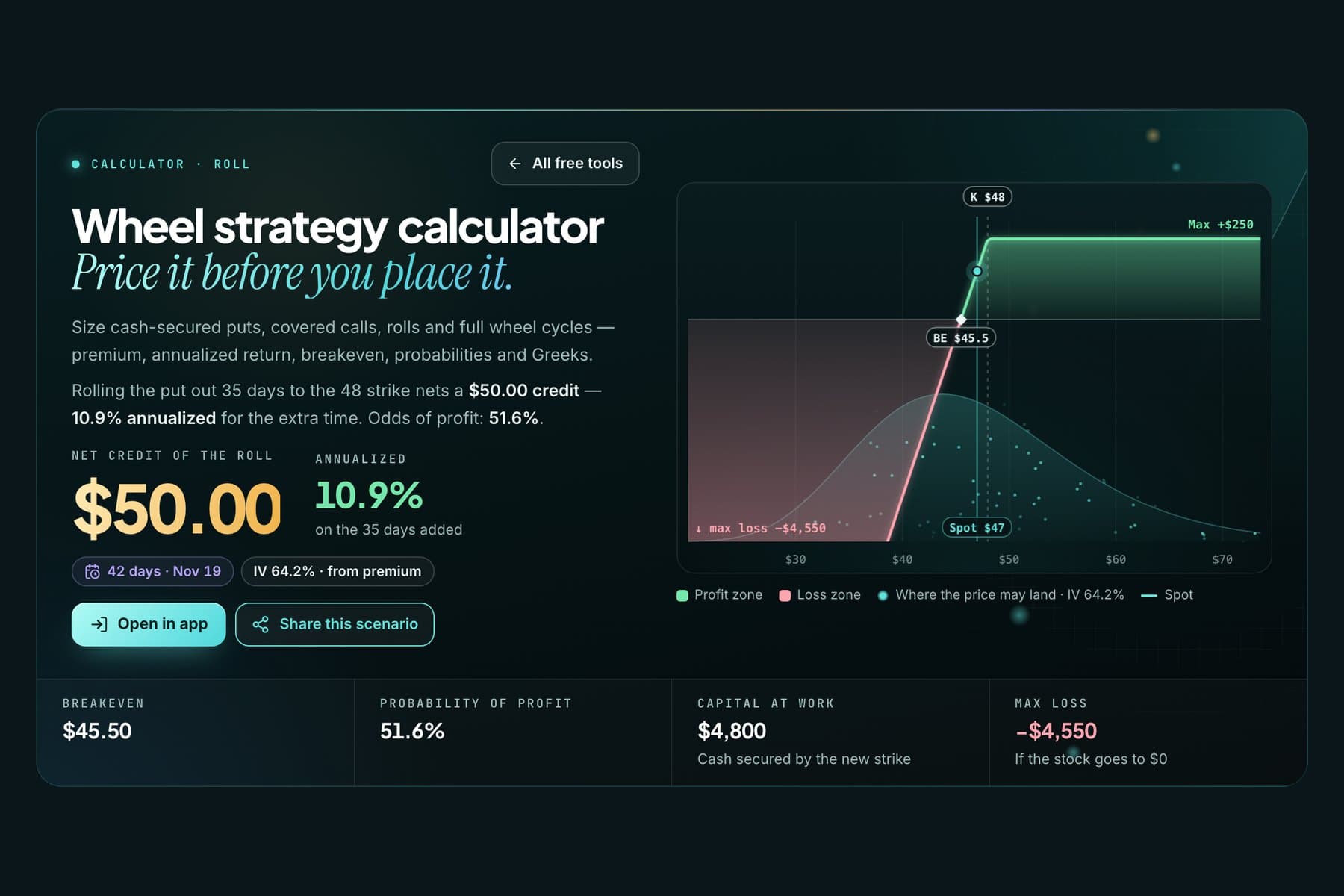
Open this example in the roll calculator and change the inputs to your own trade.
Taxes: a roll is two trades
For your records, the buy-back closes the first put, so its gain or loss is realized on that date; the new put is a separate position. In the US, a closed option's result is a short-term capital gain or loss, and if a put you wrote is assigned, its premium lowers the cost basis of the shares (IRS Publication 550). In Canada, an assigned put's premium reduces the adjusted cost base of the shares (Income Tax Act, s. 49(3.1)). Your situation decides the treatment, so check with a tax professional.
FAQ: Does rolling a put erase a loss?
No. Buying back the old put locks in its result. The new put can then make or lose money on its own. A net credit only describes the cash exchanged on the day you rolled.
FAQ: Can rolling a cash-secured put cost money?
Yes. If the new put brings in less than the old one costs to buy back, the roll is a debit. Insisting on a credit can push you toward a much later expiration or a higher strike, and neither automatically lowers your risk.
FAQ: Does rolling down prevent assignment?
No. A lower strike changes the price you'd pay, but the new put can still be assigned, including before expiration. The cash you set aside pays for the shares; it doesn't protect you from a falling stock.
FAQ: When is the best time to roll?
There's no single right day. Some traders manage every position at a fixed point, such as 21 days before expiration; others only act when the put is tested in the last week or two. Either way, roll while the old put still has some time value. Once it's deep in the money with almost none left, early assignment gets more likely and the credit gets thin.
FAQ: Can I roll after I've been assigned?
No. Assignment ends the put: you now own 100 shares per contract at the strike. The usual next step in the wheel is selling a covered call on them; the covered call calculator shows the premium and breakeven against your share cost.
Free tools to check the numbers
- Roll calculator, pre-filled with this example: net credit, breakeven and capital at work for the whole sequence.
- Cash-secured put calculator: premium, breakeven and return of the new put on its own.
- Free wheel spreadsheet (.xlsx, English or French): one row per leg, net P/L calculated for you.
- Wheel ticker pages such as $SPY, $SOFI and $PLTR: the stock, its option cycle and its assignment risks. Delayed data, for context only.
Sources
- [1]Cash-Secured Put — OCC / The Options Industry Council · Accessed 2026-10-08T09:06:16.487109+00:00 · Tier 1
- [2]Options Assignment FAQ — OCC / The Options Industry Council · Accessed 2026-10-08T09:06:16.487109+00:00 · Tier 1
- [3]Trading Options: Understanding Assignment — FINRA · Accessed 2026-10-08T09:06:16.487109+00:00 · Tier 1
- [4]General Information FAQ — OCC / The Options Industry Council · Accessed 2026-10-08T09:06:16.487109+00:00 · Tier 1
- [5]Splits, Mergers, Spinoffs & Bankruptcies FAQ — OCC / The Options Industry Council · Accessed 2026-10-08T09:06:16.487109+00:00 · Tier 1
- [6]Understanding Order Types — SEC / Investor.gov · Accessed 2026-10-08T09:08:25Z · Tier 1
- [7]Royal Exchange (London)-2 — photograph and CC BY-SA 4.0 attribution — Wikimedia Commons / Yair Haklai · Accessed 2026-10-08T09:04:58.937166Z · Tier 1
- [8]Publication 550, Investment Income and Expenses (Writers of puts and calls) — Internal Revenue Service · Accessed 2026-10-08T13:25:21+00:00 · Tier 1
- [9]Income Tax Act, section 49 (options), subsections 49(3) and 49(3.1) — Justice Laws Website, Government of Canada · Accessed 2026-10-08T13:25:21+00:00 · Tier 1
This content is for informational and educational purposes only and is not financial advice. Options involve risk and are not suitable for every investor. Do your own research before trading.
Keep YieldCove close
Choose YieldCove as a preferred source for Top Stories in Google Search.