Key takeaways
- Google announced TPU 8tx and TPU 8i Max systems on November 9, expanding its existing chip generation.
- GOOGL gained 1.18% in the closing snapshot, while AI-related peers diverged.
- Security and memory improvements are company claims, not a new revenue forecast.
- Inflation releases and an unconfirmed next earnings date still matter to option sellers.
GOOGL closing snapshot, November 9
USD 288.15
Change versus November 6
+USD 3.37 / +1.18%
Volume / prior 60-session average
36,009,408 / 29,384,362 shares
1.23 times average
Cboe 30-day IV / IV rank
32.45% / rank unverified
Delayed snapshot retrieved 16:29 ET
Next Alphabet earnings
Unconfirmed in sources reviewed
What Google announced today
Google introduced TPU 8tx and TPU 8i Max on November 9, two new systems built around its eighth-generation Tensor Processing Units, or TPUs. These are specialized computers for artificial intelligence, not an announcement of two entirely new underlying chip designs. Google says the additions bring its 2026 lineup to four TPU systems. Google announcement
Alphabet’s Class A shares, GOOGL, finished the provider’s November 9 closing snapshot at USD 288.15, up USD 3.37, or 1.18%, from November 6. Volume was 36,009,408 shares, about 1.23 times the preceding 60 completed sessions’ average of 29,384,362. These are dated market observations, not live offers, and the product announcement alone does not establish why every investor bought or sold. GOOGL price data
AI-linked shares diverged on November 9
November 9 versus November 6 close; provider snapshots at 16:00:00–16:00:01 ET. Different businesses, not a controlled product comparison.
Source: Yahoo Finance daily-price API, retrieved November 9, 2026 at 16:29 ET; returns calculated from original prior closes. Rounded to two decimals.
Why security and memory are the selling points
AI agents are software that can work through several tasks and tools rather than answer one isolated question. Google is targeting two practical bottlenecks: protecting sensitive information during processing, and supplying enough memory bandwidth for large workloads. Its pitch is that changing the surrounding computer system can address customer needs faster than waiting for another chip-design cycle. System-versus-chip explanation
| System | What changed | Intended use |
|---|---|---|
| TPU 8tx | TPU 8t silicon plus AMD EPYC hosts and confidential computing | Sensitive enterprise and government workloads |
| TPU 8i Max | Two TPU 8i chips in one package; double compute and memory bandwidth | Large context windows and denser racks |
Google says TPU 8tx uses fifth-generation AMD EPYC host processors and keeps data and model weights isolated while in use. For TPU 8i Max, it describes twice the compute, SRAM memory and high-bandwidth-memory bandwidth of TPU 8i. Those are vendor specifications, not proof that every customer’s application becomes twice as fast or profitable. Technical claims
AMD therefore appears here as a component partner, not simply a company displaced by Google’s custom hardware. Market reactions were also mixed: AMD rose 13.26% and Nvidia fell 4.27% in their November 9 closing snapshots. The contrast supplies sector context; it does not prove this launch caused either peer’s move. AMD data; Nvidia data
A new computer system is not a new earnings forecast.
The financial test is customer spending, not specifications
Alphabet’s latest reported quarter ended September 30, with results released October 28. Revenue rose 25% year over year to USD 127.6 billion; Google Cloud revenue increased 103% to USD 30.7 billion, while diluted earnings per common share were USD 2.12. Those results predate today’s launch, so they cannot measure sales generated by these new configurations. Alphabet results
On that earnings call, management kept full-year 2026 capital-expenditure guidance at USD 195–205 billion. It also explained that inventory for TPU system sales can consume cash before delivery and customer billing bring money in. The business opportunity is real customer adoption; the unanswered question is how efficiently that demand becomes cash after infrastructure costs. Management’s outlook and cash-cycle explanation
What it means for option sellers
Cboe’s delayed snapshot retrieved November 9 at 16:29 ET displayed 30-day implied volatility of 32.449%, rounded here to 32.45%. A comparable IV rank was not verified, so this article cannot call that reading historically expensive or cheap. IV describes option pricing expectations, not a promised realized move, and readers must check live prices before any trade. Cboe snapshot
For the wheel, a short put can lead to buying shares, while a covered call can require selling shares already held. Alphabet’s next earnings date was not confirmed in the sources reviewed; a later expiry must not be described as earnings-free. A product release does not remove the risk of an earnings gap, a market selloff or early assignment. Assignment mechanics
Educational arithmetic—not a quoted setup
Imagine a standard 100-share put with a USD 270 strike and an invented USD 3 premium: cash backing is USD 27,000, gross credit USD 300 and expiry breakeven USD 267. If the stock reaches zero, the loss is USD 26,700 before fees. A hypothetical USD 310 covered call would cap the share-sale price at USD 310. These strikes and premiums are teaching assumptions, not verified listings, executable prices or recommendations.
The main risk
Better hardware does not guarantee better investment returns. Adoption, pricing, inventory funding and infrastructure costs can disappoint, while a stock-price gap can exceed the premium collected. A covered call also limits participation if the shares rally sharply.
- Risk review: separate Google’s technical claims from independently measured customer outcomes.
- Calendar review: check earnings and inflation dates against the actual option expiry.
- Management framework: reassess cash backing, assignment willingness and exit costs before exposure; rolling changes risk rather than erasing a loss.
What to watch next
The November 6 U.S. jobs release showed October payroll growth of 165,000 and unemployment of 4.1%. That is the recent macro backdrop, not a single-cause explanation for GOOGL’s move. The next inflation reports can change the wider rate and valuation debate. BLS employment report
- November 10, 08:30 ET: October Consumer Price Index.
- November 13, 08:30 ET: October Producer Price Index.
- Next Alphabet results: date unconfirmed here; watch for customer adoption, cash conversion and updated spending guidance. Official BLS calendar
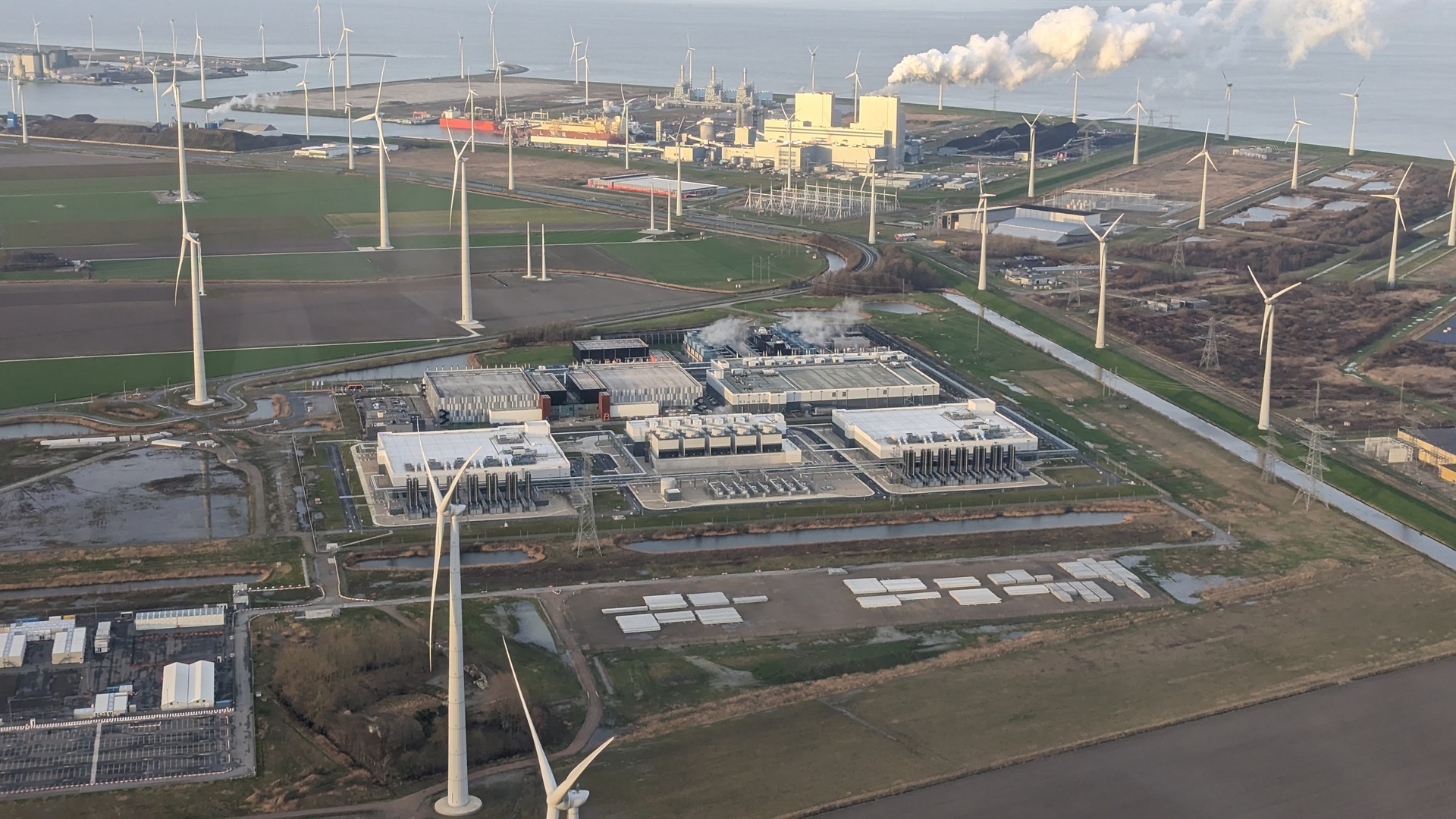
The hero is an archival aerial photograph of Google’s Eemshaven data center, not the new TPU hardware. Photo: Wvdp, Wikimedia Commons, CC0 1.0; resized.
Sources
- [1]TPU 8tx and TPU 8i Max announcement, November 9 — Google · Accessed 2026-11-09T21:29:08.499372+00:00 · Tier 1
- [2]Technical system specifications, November 9 — Google Cloud · Accessed 2026-11-09T21:29:08.801635+00:00 · Tier 1
- [3]Alphabet Q3 2026 earnings release, October 28 — Alphabet · Accessed 2026-11-09T21:32:19.874365+00:00 · Tier 1
- [4]Alphabet Q3 2026 call transcript, October 28 — Alphabet Investor Relations · Accessed 2026-11-09T21:29:08.606784+00:00 · Tier 1
- [5]GOOGL daily price and volume snapshot — Yahoo Finance · Accessed 2026-11-09T21:29:08.566873+00:00 · Tier 3
- [6]AMD daily price snapshot — Yahoo Finance · Accessed 2026-11-09T21:29:08.655851+00:00 · Tier 3
- [7]NVDA daily price snapshot — Yahoo Finance · Accessed 2026-11-09T21:29:08.528182+00:00 · Tier 3
- [8]GOOGL delayed options snapshot: 30-day IV — Cboe · Accessed 2026-11-09T21:29:09.225932+00:00 · Tier 1
- [9]Options assignment mechanics — Options Industry Council · Accessed 2026-11-09T21:27:48.709579+00:00 · Tier 1
- [10]Google Eemshaven archival photograph and rights — Wvdp / Wikimedia Commons · Accessed 2026-11-09T21:30:09.086316+00:00 · Tier 1
- [11]CC0 1.0 Universal Public Domain Dedication — Creative Commons · Accessed 2026-11-09T21:30:08.769452+00:00 · Tier 1
- [12]October 2026 employment report, released November 6 — U.S. Bureau of Labor Statistics · Accessed 2026-11-09 · Tier 1
- [13]November 2026 official release schedule — U.S. Bureau of Labor Statistics · Accessed 2026-11-09 · Tier 1
This content is for informational and educational purposes only and is not financial advice. Options involve risk and are not suitable for every investor. Do your own research before trading.
Keep YieldCove close
Choose YieldCove as a preferred source for Top Stories in Google Search.
Run the numbers before you trade: the free wheel strategy calculator sizes the whole cycle, and the cash-secured put calculator shows the cash, return and breakeven of one put.