Key takeaways
- AbbVie reported US$17.404 billion of quarterly sales, up 10.3%, and raised its 2026 adjusted earnings outlook. [1]
- Skyrizi and Rinvoq growth outweighed another Humira decline. [1]
- The quarterly dividend rises to US$1.82 starting with the February 2027 payment, not immediately. [1]
- Post-earnings option sellers still face drug-development, pricing and assignment risks. [1][7][8]
ABBV, about 14:03 ET, Oct 30 [2]
US$295.95
+US$5.16 / +1.77% vs prior close
Partial-session volume [2][3]
2,897,185 shares
55.42% of prior-20-session daily average
30-day implied volatility [2]
27.01%
IV rank not independently available
Q3 revenue, ended Sept 30 [1]
US$17.404B
+10.3% reported year over year
New quarterly dividend [1]
US$1.82
Payable February 16, 2027
What happened: a better outlook and a bigger dividend
AbbVie released third-quarter results on October 30, combining double-digit revenue growth with a higher full-year earnings outlook and a dividend increase. Sales reached US$17.404 billion for the quarter ended September 30, versus US$15.776 billion a year earlier. The investment question is whether newer medicines can keep carrying growth as older products shrink. [1]
In the saved Cboe snapshot, ABBV traded at US$295.95, up US$5.16, or a calculated 1.77%, from the October 29 close of US$290.79. The snapshot was retrieved around 14:18 ET and was approximately 15 minutes delayed, placing the observation around 14:03 ET. These are timestamped figures, not live offers; check live prices before trading. [2]
Volume at that cut was 2,897,185 shares, compared with an average 5,227,580 shares across the previous 20 completed sessions. That is 55.42% of a full-session average, not a time-of-day-adjusted relative-volume signal. The chart excludes today’s unfinished session so readers can separate completed closes from an intraday reaction. [2][3]
ABBV: 20 completed-session closes
October 2–29, 2026. Unadjusted closes; October 30 intraday trading excluded. [3]
Source: Yahoo Finance [3]; October 2–29, 2026 daily closes; retrieved October 30 at 14:18 ET.
Why the results matter: the product handover is working
Skyrizi revenue rose 22.7% to US$5.776 billion and Rinvoq rose 23.9% to US$2.706 billion. Together, those medicines generated a calculated US$8.482 billion, or 48.74% of group sales. Humira revenue fell 31.2% to US$683 million, but the whole immunology portfolio still grew 16.3% to US$9.165 billion. That is the clearest operating driver in the release. [1]
| Measure | Result | Comparison or qualification |
|---|---|---|
| Neuroscience revenue | 3.389 | +19.4% reported year over year |
| Oncology revenue | 1.696 | +0.8% reported year over year |
| Aesthetics revenue | 1.176 | −1.4% reported year over year |
| Diluted EPS, GAAP | US$2.37 | US$0.10 a year earlier |
| Adjusted diluted EPS, non-GAAP | US$3.82 | US$1.86 a year earlier |
| Acquired research/milestone EPS impact | −US$0.11 | Included in both Q3 EPS measures |
The earnings jump needs care. Acquired in-process research and development and milestone expense was US$216 million before tax, versus about US$2.7 billion a year earlier. Both GAAP and adjusted earnings include those expenses. The much smaller charge helps the year-over-year comparison; it would be misleading to describe the entire EPS increase as recurring product growth. Adjusted figures also exclude other specified items and do not replace GAAP results. [1]
Management raised and narrowed 2026 adjusted diluted EPS guidance from US$13.76–13.96 to US$13.95–13.99. The calculated midpoint increases by US$0.11, from US$13.86 to US$13.97. Importantly, the range includes acquired research and milestone costs incurred through September, but excludes any such costs after the third quarter because they cannot be reliably forecast. This is management’s outlook, not a guaranteed result. [1]
- The new quarterly dividend of US$1.82 compares with US$1.73, a calculated 5.20% increase. It is payable February 16, 2027, to holders of record January 15, 2027. A record date is not being presented here as a separately verified ex-dividend date. [1]
- Healthcare peers were also higher: later Yahoo observations around 14:17 ET showed Johnson & Johnson up 0.29% and Lilly up 3.81% versus October 29 closes. These are not synchronized with Cboe’s delayed ABBV snapshot. [4][5]
- The Fed held its policy range at 3.75%–4.00% on October 28. That financing and valuation backdrop is relevant, but neither the rate decision nor sector gains establish the cause of ABBV’s entire move. [6]
Faster sales and a bigger dividend do not remove drug-development risk. [1]
What it means for option sellers
Cboe’s saved 30-day implied volatility reading was 27.011%, rounded here to 27.01%. IV rank was not independently available, so this article does not label premiums historically rich or cheap. With the earnings release now public, a seller cannot assume the premium available before the announcement remains available afterward. Fresh bid/ask quotes and the exact contract calendar still matter. [2][7][8]
The wheel does not insure the shares
A cash-secured put can become ownership of stock worth much less than the strike. Writing covered calls after assignment retains that downside and caps part of the recovery. AbbVie also flags competition, drug-pricing reform and development risks; a dividend does not make these disappear. [1][7][8]
Educational arithmetic—not a quoted trade
For a hypothetical standard 100-share US$280 put sold for an assumed US$2.50 per share, premium is US$250 and strike cash is US$28,000. Expiry breakeven is US$277.50; maximum option profit is US$250, while loss could reach US$27,750 if shares became worthless, before fees and taxes. No executable premium, expiry or attractive yield is claimed. [7][9]
Likewise, a hypothetical US$310 covered-call strike accepts a possible sale of the covered shares at US$310 even if the market later rises further. Whether that produces an overall gain depends on share cost, premium and fees. It illustrates the obligation rather than a suggested strike, and no personal account or trade is involved. [8]
What to watch next
| Date | Checkpoint | Why it matters |
|---|---|---|
| November 6, 2026, 08:30 ET | October Employment Situation | Broad rates and risk-appetite context |
| November 10, 2026, 08:30 ET | October Consumer Price Index | Inflation and valuation context |
| January 15, 2027 | New dividend record date | Not an independently verified ex-date |
| February 16, 2027 | US$1.82 dividend payment | First payment at the new rate |
- Track whether Skyrizi and Rinvoq maintain growth without overlooking the weaker aesthetics portfolio. [1]
- Check the issuer calendar for the next earnings date before selecting an expiry; this article does not establish that date.
- For covered calls, independently confirm the ex-dividend date and review early-assignment exposure, not just the payment date. [8]
The useful takeaway is narrower than “higher dividend, safer stock.” AbbVie’s growth engines strengthened and the earnings midpoint moved up, but the cost exclusions and product concentration deserve equal attention. This is educational market information, not personal financial advice; option losses can substantially exceed the premium collected.
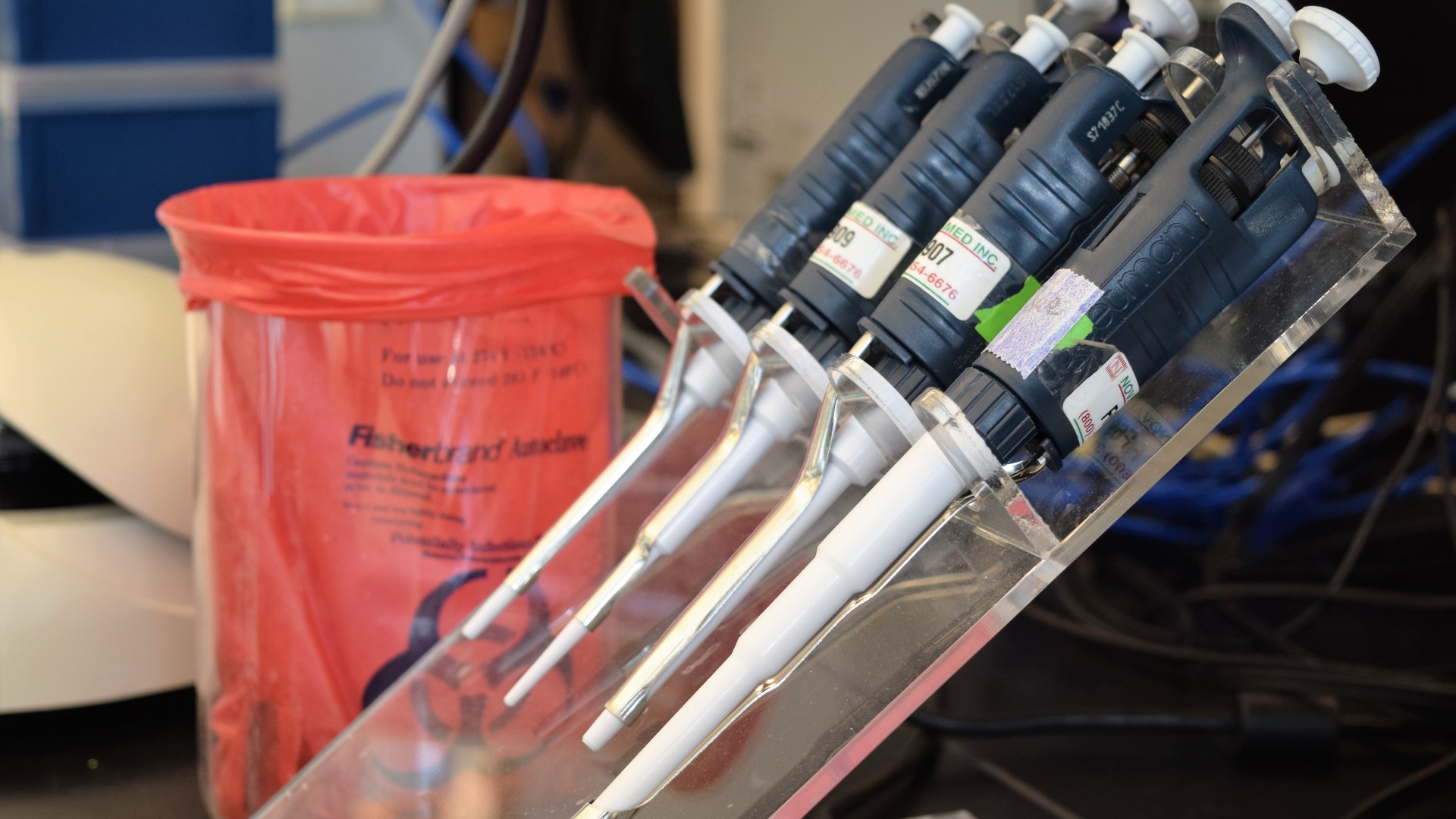
Archival illustrative hero: laboratory pipettes photographed in 2015, not identified as an AbbVie facility or product. Photo by J.N. Eskra / Wikimedia Commons; cropped and resized. The adapted photograph is licensed CC BY-SA 4.0. [11][12]
Sources
- [1]Third-quarter 2026 financial results and dividend declaration — AbbVie · Accessed 2026-10-30T14:20:08.894090-04:00 · Tier 1
- [2]ABBV delayed quote and 30-day implied volatility, October 30 — Cboe Global Markets · Accessed 2026-10-30T14:18:38.143598-04:00 · Tier 1
- [3]ABBV daily history, 20 completed sessions used — Yahoo Finance · Accessed 2026-10-30T14:18:38.144456-04:00 · Tier 3
- [4]Johnson & Johnson October 30 market snapshot — Yahoo Finance · Accessed 2026-10-30T14:18:38.145165-04:00 · Tier 3
- [5]Eli Lilly October 30 market snapshot — Yahoo Finance · Accessed 2026-10-30T14:18:38.145718-04:00 · Tier 3
- [6]October 28, 2026 FOMC statement — Federal Reserve · Accessed 2026-10-30T14:20:08.896298-04:00 · Tier 1
- [7]Cash-secured put: obligations and risks — Options Industry Council / OCC · Accessed 2026-10-30T14:20:08.894497-04:00 · Tier 1
- [8]Covered call: downside, upside cap and assignment — Options Industry Council / OCC · Accessed 2026-10-30T14:20:08.894922-04:00 · Tier 1
- [9]Equity options basics and contract size — Options Industry Council / OCC · Accessed 2026-10-30T14:20:08.895530-04:00 · Tier 1
- [10]November 2026 selected release calendar — U.S. Bureau of Labor Statistics · Accessed 2026-10-30T14:41:29.949482-04:00 · Tier 1
- [11]Laboratory pipettes: real-photo authorship and license — Wikimedia Commons · Accessed 2026-10-30T14:20:08.892135-04:00 · Tier 4
- [12]Creative Commons Attribution-ShareAlike 4.0 license — Creative Commons · Accessed 2026-10-30T14:20:08.892955-04:00 · Tier 4
This content is for informational and educational purposes only and is not financial advice. Options involve risk and are not suitable for every investor. Do your own research before trading.
Keep YieldCove close
Choose YieldCove as a preferred source for Top Stories in Google Search.
Run the numbers before you trade: the free wheel strategy calculator sizes the whole cycle, and the cash-secured put calculator shows the cash, return and breakeven of one put.