
Oil eases, but 5% Treasuries keep the Fed-day pressure on
A modest rebound in equity futures is running into stubbornly high bond yields before the Fed decision. For premium sellers, the distinction between temporary oil relief and lasting policy risk matters more than a greener opening screen.
YieldCove Desk
3 min read
S&P 500 Dec futures [1–2]
+0.20%
Brent Nov · USD/barrel [1–2]
107.75
US 10-year yield [1,3]
5.008%
VIX · points [1,3]
17.10
Oil is offering stocks a breather, but bonds are not offering a clean escape. With the benchmark Treasury yield near 5% and the Federal Reserve decision still ahead, firmer equity futures look more like a pause in pressure than a settled turn in the market. For premium sellers, the central question is whether compensation for uncertainty survives the policy announcement—not simply whether stocks open higher. [1–3,6]
Morning Read, September 16, 2026. Market observations span 03:58–04:08 EDT, New York/Toronto time; futures and international stock-index quotes are delayed. Commodity prices are in US dollars. These are reference snapshots, not executable prices. [1–3]
Macro overnight
December S&P 500 futures rose 0.20% and Nasdaq-100 futures gained 0.41%. Asia offered a firmer backdrop: the Nikkei was up 0.69%, Korea’s KOSPI 1.37% and Hong Kong’s Hang Seng 0.21% in their respective observations. Early European trading was also positive, with the FTSE 100 up 0.37% and Germany’s DAX up 0.19%. That breadth matters, but a modest regional rebound does not remove the financing-cost hurdle for growth shares. [1–3]
November Brent eased 0.92% to USD 107.75 a barrel; October WTI traded at USD 104.28. December gold stood at USD 4,368.60 per troy ounce and the dollar index at 99.62 points. Cheaper crude helps the inflation narrative at the margin, but oil remains an input cost, not a verdict on monetary policy. Gold’s strength alongside higher equity futures also argues against describing this as an unqualified rush into risk. [1–3]
The overnight two-year Treasury yield was 4.666%, against 5.008% for the ten-year. More importantly, the official daily curve shows a persistent repricing: between September 4 and September 15, the two-year rose 30 basis points and the ten-year 22 basis points. Those daily par yields are a different observation from the overnight trading quotes. The chart shows the broader move, rather than treating a brief oil retreat as proof that inflation pressure has disappeared. [1,3–4]
Higher yields now reach across the Treasury curve
Daily par yields (%), September 4 versus September 15, 2026; not overnight quotes. [4]
Source: U.S. Treasury · 2026-09-16 [4]
The VIX was 17.10 points overnight, versus an official September 15 close of 17.20. That broad equity-volatility gauge does not price an individual company’s earnings or acquisition risk. Separately, the Senate’s failure to advance crypto market-structure legislation adds policy uncertainty around digital assets; it is a procedural setback, not a new ban on owning cryptocurrency. [1,3,5,14–15]
Your tickers
GRAB — In his September 16 interview, CFO Peter Oey stressed the staged structure of the Atome acquisition announced September 15. The initial USD 1.49 billion buys a proposed 60% stake, including USD 0.26 billion of growth capital; the remaining 40% has a performance-linked price, not a fixed follow-on bill. Initial closing is expected by the third quarter of 2027, subject to approvals and other conditions. This expands the lending opportunity while leaving credit quality, integration and future cash demands central to the investment debate. [11–13]
What this means for premium sellers
A rising risk-free benchmark raises the hurdle for taking equity downside. The Treasury’s three-month par yield was 4.11% on September 15, a comparison point rather than the return paid on brokerage cash. A put premium collected before the Fed announcement compensates for a possible price gap as well as time passing; it does not neutralize that gap. For covered calls, a larger credit still leaves most share-price downside intact and can cap a relief rally. Broad-market volatility and company-specific deal risk therefore belong in separate parts of the assessment. [4]
What to watch today
| Time | Release | Why it matters |
|---|---|---|
| 08:30 | August retail sales; August import/export prices [7–9] | Demand resilience and imported price pressure |
| 10:00 | July business inventories [7,9] | Stockbuilding versus final demand |
| 10:30 | Weekly petroleum inventory release [10] | Official supply-and-stock evidence after the oil pullback |
| 14:00 / 14:30 | FOMC decision / press conference [6] | Policy action, then the explanation and outlook |
The morning data can change the interpretation of the afternoon decision. Strong spending alongside firm import prices would sharpen the growth-versus-inflation tension; softer demand would shift attention toward the cost of tighter policy. After the announcement, the useful question is whether bonds, oil and equities tell a consistent story—not whether the first price move confirms a preferred forecast. [6–10]
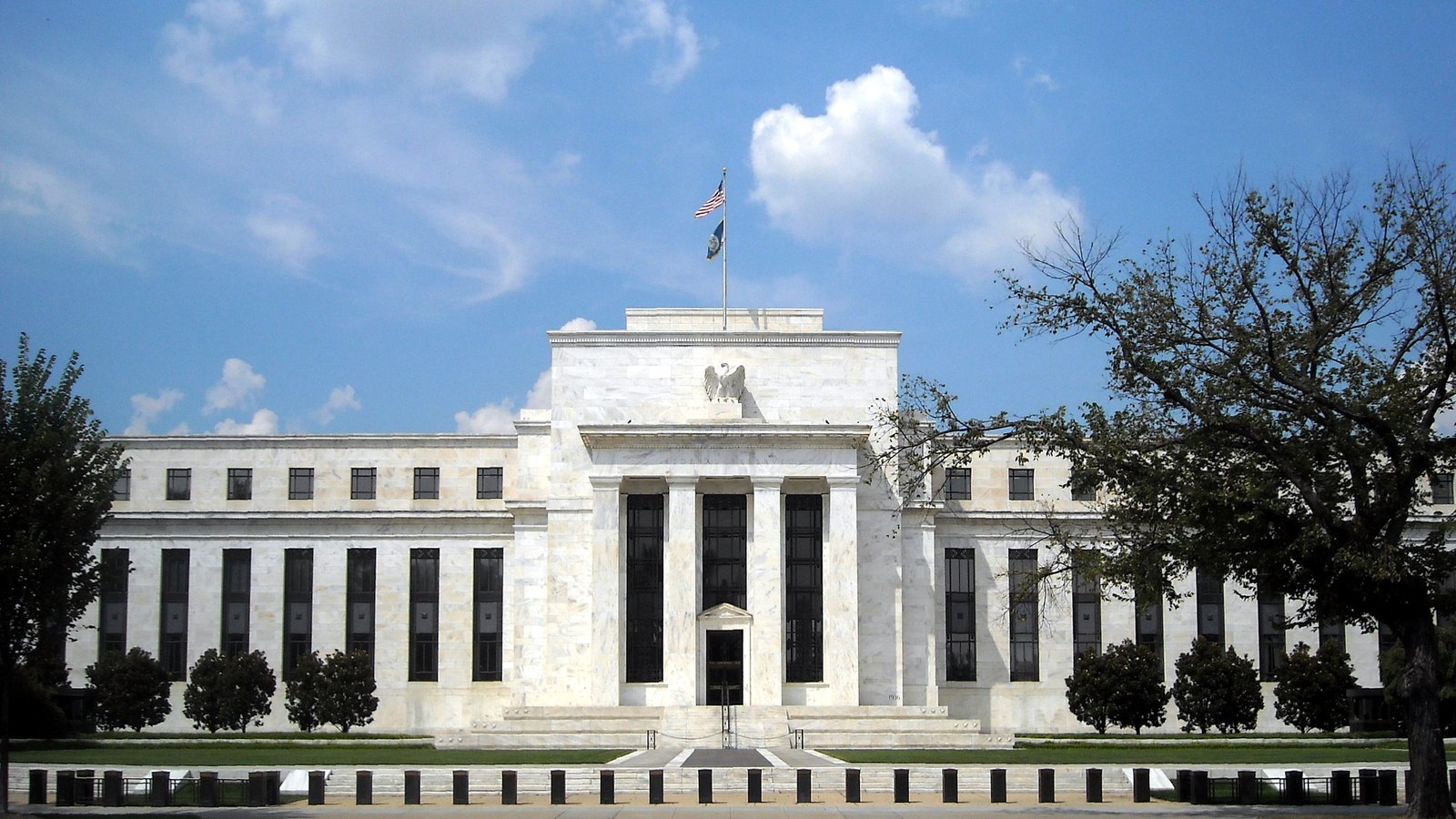
Photograph: the Eccles Building in Washington, August 2008, by AgnosticPreachersKid. Cropped and resized; CC BY-SA 3.0, with the adapted photograph shared under the same license. [16–17]
Sources
- [1]Global market snapshot — September 16, 2026 — CNBC · Accessed 2026-09-16T08:08:41.296789+00:00 · Tier 2
- [2]December equity and front-month commodity futures — TradingView · Accessed 2026-09-16T08:08:41.273865+00:00 · Tier 2
- [3]Global cash indices, yields and dollar snapshot — TradingView · Accessed 2026-09-16T08:08:41.234191+00:00 · Tier 2
- [4]Daily Treasury par yields — September 2026 — U.S. Treasury · Accessed 2026-09-16T08:09:00.453807+00:00 · Tier 1
- [5]Daily VIX history — Cboe · Accessed 2026-09-16T08:08:41.344790+00:00 · Tier 1
- [6]September 2026 FOMC decision and press conference — Federal Reserve · Accessed 2026-09-16T08:08:41.297142+00:00 · Tier 1
- [7]September 2026 economic indicators calendar — Federal Reserve Bank of New York · Accessed 2026-09-16T08:08:41.677312+00:00 · Tier 1
- [8]September 2026 release schedule — Bureau of Labor Statistics · Accessed 2026-09-16T08:08:41.248708+00:00 · Tier 1
- [9]Economic indicators release calendar — U.S. Census Bureau · Accessed 2026-09-16T08:08:41.633374+00:00 · Tier 1
- [10]Weekly Petroleum Status Report schedule — U.S. Energy Information Administration · Accessed 2026-09-16T08:12:10.087599+00:00 · Tier 1
- [11]Grab Form 6-K — Atome acquisition, September 15, 2026 — Grab / SEC · Accessed 2026-09-16T08:12:10.033186+00:00 · Tier 1
- [12]Atome transaction terms — Exhibit 99.1 — Grab / SEC · Accessed 2026-09-16T08:13:06.360312+00:00 · Tier 1
- [13]Grab CFO discusses the Atome transaction on September 16 — CNBC · Accessed 2026-09-16T08:10:43.818702+00:00 · Tier 2
- [14]Senate procedural vote stalls the Clarity Act — CNBC · Accessed 2026-09-16T08:10:44.082420+00:00 · Tier 2
- [15]Wall Street declines and cryptocurrency legislation stalls — Reuters via MarketScreener · Accessed 2026-09-16T08:08:44.161754+00:00 · Tier 2
- [16]Eccles Building photograph — creator and attribution — Wikimedia Commons / AgnosticPreachersKid · Accessed 2026-09-16T08:12:38.332111+00:00 · Tier 1
- [17]Creative Commons Attribution-ShareAlike 3.0 — Creative Commons · Accessed 2026-09-16T08:12:38.421970+00:00 · Tier 1
This content is for informational and educational purposes only and is not financial advice. Options involve risk and are not suitable for every investor. Do your own research before trading.
Read next

Cheaper oil lifts futures, but Japan adds another rate hurdle
Falling oil and stronger equity futures extend the relief rally even as Japan tightens monetary policy. For premium sellers, calmer broad-market volatility must still be weighed against elevated bond yields and company-specific risks.
Futures rebound, but the Fed keeps the funding hurdle high
Equity futures are recovering as oil and volatility ease after the Fed’s rate increase. For premium sellers, the rebound does not erase higher financing costs or the distinction between cash yield and compensation for assignment risk.

Oil and a 5% Treasury yield squeeze the room for stocks
Oil’s renewed climb and a higher discount rate are pressing on equities before the Fed decision. For premium sellers, richer volatility now comes with a tougher test of downside exposure and collateral returns.