
Futures rebound, but the Fed keeps the funding hurdle high
Equity futures are recovering as oil and volatility ease after the Fed’s rate increase. For premium sellers, the rebound does not erase higher financing costs or the distinction between cash yield and compensation for assignment risk.
YieldCove Desk
3 min read
Fed target range [1]
3.75–4.00%
December S&P futures [3–4]
+0.74%
Brent · USD/barrel [3–4]
104.79
Overnight VIX [3,5]
16.12
Stocks are trying to rebound after a rate increase, not celebrating a return to easy money. Lower oil and calmer overnight volatility offer relief, but the bond market still sets a demanding hurdle for expensive equities. For option sellers, that combination separates a better opening tone from a genuinely safer price for taking assignment.
Macro overnight
On September 16, 2026, the Federal Reserve raised its target range by 25 basis points to 3.75–4.00%, with a 12–0 vote. Its statement described solid economic activity and still-elevated inflation. The new projections put the median year-end policy-rate midpoint at 4.1% in both 2026 and 2027. That is the participants’ conditional outlook, not a promised path. Their 2026 PCE inflation projection rose to 3.7% from June’s 3.6%, reinforcing the tension between resilient demand and price stability. [1–2]
The September 17 snapshot below is indicative and includes delayed quotes; markets were observed at different moments. December S&P futures were up 0.74% and Nasdaq futures 0.88% at 03:58 EDT. Asia was mixed rather than uniformly risk-on, while European shares opened firmer. These are overnight observations, not a forecast of the cash-market close. [3–5]
| Market | Move | Reading |
|---|---|---|
| Nikkei 225 | +0.33% | Japan finished higher |
| KOSPI | −0.04% | South Korea nearly flat |
| Hang Seng | About −0.5% | Late-session Hong Kong weakness |
| DAX | +0.51% | Early European rebound |
| FTSE 100 | Higher | UK participated in the rebound |
At 04:08 EDT, the two-year Treasury yielded 4.707% and the ten-year 4.988%. The longer view is less comforting: official daily par yields rose 37 basis points at two years and 23 at ten years between September 4 and September 16. The chart uses those daily observations, not the overnight quotes. A small morning dip therefore leaves much of the recent increase in financing costs intact. [3,5–6]
Treasury yields remain above early-September levels
Annualized par yield (%); September 4 versus September 16, 2026. [6]
Source: U.S. Treasury · daily par yield curve · accessed 2026-09-17
Oil supplied the relief: November Brent was USD 104.79 a barrel and October WTI USD 101.61, still expensive despite falling. December gold stood at USD 4,365.70 per troy ounce in the delayed 03:58 EDT observations; the dollar index was 100.21 at 04:08 EDT. VIX was 16.12 then, below its September 16 official close of 17.71. Lower index volatility means less broad-market fear, not the disappearance of company-specific gaps. [3–5,7]
Your tickers
- AMZN — Generac’s September 16 filing describes expected initial backup-generator deliveries of USD 2.4 billion in 2027–2028. The USD 8 billion figure is a cumulative payment threshold for warrant vesting, not an unconditional new order; the distinction matters for judging AI infrastructure spending. [8]
- EOSE — An after-close amendment adds separation terms for Nathan Kroeker, the former chief commercial officer, including twelve months of salary continuation at USD 470,000 annually. His October 20 departure was already disclosed on August 25; this is new compensation detail, not a surprise executive exit. [9]
The premium seller’s trade-off
A rebound can lift shares while shrinking the premium offered for accepting their downside. Higher financing costs still weigh on businesses whose profits lie far in the future, so a greener index does not resolve valuation risk. The September 16 three-month Treasury par yield was 4.14%, a cash benchmark rather than the rate a broker necessarily pays on collateral. Option income has to be considered alongside that alternative and the capital exposed to assignment, not as an isolated percentage. Broad VIX also says little about the liquidity or event risk of an individual contract. [6–7]
What to watch today
- September 17, 08:30 EDT — Initial unemployment claims, August housing starts and permits, and the September Philadelphia Fed manufacturing survey arrive together. Employment resilience and construction sensitivity to rates offer complementary tests of the Fed’s outlook. [10–12]
- September 17, 10:00 EDT — Pending home sales provide another housing checkpoint. The useful comparison is whether housing demand and financing conditions are moving together, rather than assuming that the futures rebound already settles the growth question. [10]
- September 17, 23:59 EDT — The FOMC monetary-policy communications blackout ends under the day-after-meeting rule. The Board calendar next lists Michelle Bowman speaking on stress testing on September 18 at 09:30 EDT; that topic is not a promised rate-policy signal. [13–14]
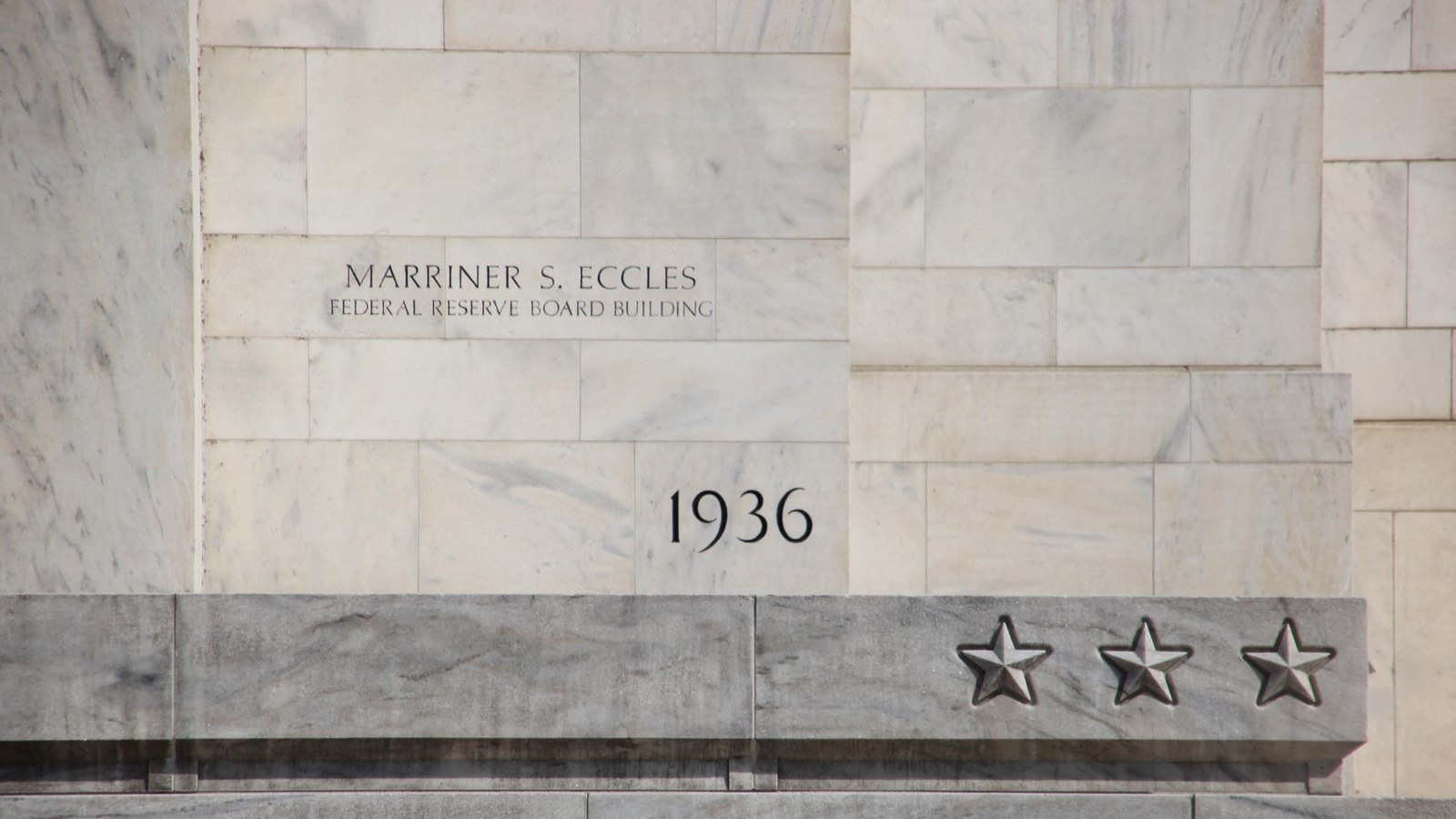
Photograph: the Eccles Building’s cornerstone and steps in Washington, September 2012, by Tim Evanson. Cropped and resized; the adapted photograph remains under CC BY-SA 2.0. [15–16]
Sources
- [1]FOMC statement — September 16, 2026 — Federal Reserve · Accessed 2026-09-17T08:08:58.981144+00:00 · Tier 1
- [2]September 2026 economic projections — Federal Reserve · Accessed 2026-09-17T08:08:59.031685+00:00 · Tier 1
- [3]Global market snapshot — September 17, 2026 — CNBC · Accessed 2026-09-17T08:08:58.736516+00:00 · Tier 2
- [4]December equity and front-month commodity futures — TradingView · Accessed 2026-09-17T08:08:58.739365+00:00 · Tier 2
- [5]Global indices, Treasury yields and dollar — TradingView · Accessed 2026-09-17T08:08:58.732508+00:00 · Tier 2
- [6]Daily Treasury par yields — September 2026 — U.S. Treasury · Accessed 2026-09-17T08:09:15.815506+00:00 · Tier 1
- [7]Daily VIX history — Cboe · Accessed 2026-09-17T08:08:58.841610+00:00 · Tier 1
- [8]Generac and Amazon supply agreement and warrants — September 16, 2026 — Generac / SEC · Accessed 2026-09-17T08:13:34.837969+00:00 · Tier 1
- [9]Eos executive separation agreement — September 16, 2026 — Eos Energy / SEC · Accessed 2026-09-17T08:12:10.312255+00:00 · Tier 1
- [10]September 2026 economic indicators calendar — Federal Reserve Bank of New York · Accessed 2026-09-17T08:08:59.171824+00:00 · Tier 1
- [11]Economic indicators release calendar — U.S. Census Bureau · Accessed 2026-09-17T08:08:59.016426+00:00 · Tier 1
- [12]Manufacturing Business Outlook Survey release calendar — Federal Reserve Bank of Philadelphia · Accessed 2026-09-17T08:08:59.805678+00:00 · Tier 1
- [13]Policy on external communications of FOMC participants — Federal Reserve · Accessed 2026-09-17T08:13:11.295862+00:00 · Tier 1
- [14]September 2026 Board events calendar — Federal Reserve · Accessed 2026-09-17T08:08:58.791198+00:00 · Tier 1
- [15]Federal Reserve Building cornerstone photograph — Tim Evanson / Wikimedia Commons · Accessed 2026-09-17T08:12:40.845531+00:00 · Tier 1
- [16]Creative Commons Attribution-ShareAlike 2.0 — Creative Commons · Accessed 2026-09-17T08:12:40.971270+00:00 · Tier 1
This content is for informational and educational purposes only and is not financial advice. Options involve risk and are not suitable for every investor. Do your own research before trading.
Read next

Cheaper oil lifts futures, but Japan adds another rate hurdle
Falling oil and stronger equity futures extend the relief rally even as Japan tightens monetary policy. For premium sellers, calmer broad-market volatility must still be weighed against elevated bond yields and company-specific risks.
Oil eases, but 5% Treasuries keep the Fed-day pressure on
A modest rebound in equity futures is running into stubbornly high bond yields before the Fed decision. For premium sellers, the distinction between temporary oil relief and lasting policy risk matters more than a greener opening screen.

Oil and a 5% Treasury yield squeeze the room for stocks
Oil’s renewed climb and a higher discount rate are pressing on equities before the Fed decision. For premium sellers, richer volatility now comes with a tougher test of downside exposure and collateral returns.