Verizon raised its 2026 outlook on October 26 after stronger subscriber growth, and announced an Amazon Web Services agreement valued above US$2 billion. But better guidance did not prevent a morning share-price decline. The key tension: improving service revenue and cash generation versus weaker equipment sales. This expanded update keeps the original morning news frame; the prices below are dated historical observations, not live quotes.[1][3]
What happened: results improved, shares fell
Yahoo’s retrospectively retrieved October 26 minute bar for 10:47–10:48 a.m. Toronto time closed at US$43.645, down US$1.015, or 2.27%, from Friday’s US$44.66 close. That is a vendor minute-bar close, not an exact publication-time trade. For completed-session volume context, Yahoo records 51,094,800 shares on October 23, when VZ fell US$0.54, or 1.19%. Friday’s volume is not Monday’s morning turnover.[2][3]
For the third quarter, Verizon reported US$34.3 billion of operating revenue, up 1.5% year over year; US$5.3 billion of consolidated net income; and US$1.25 of GAAP earnings per share. Adjusted EPS was US$1.31, up 8.3%. Operating cash flow reached US$11.5 billion and free cash flow US$7.8 billion. Adjusted EPS and free cash flow are non-GAAP measures, not substitutes for reported profit or operating cash flow.[1]
The company added 406,000 net postpaid phone connections and 137,000 net postpaid accounts—different measures, not interchangeable customer totals. Full-year phone-addition guidance rose to 1.1 million–1.2 million, from the upper half of 750,000–1 million. Adjusted EPS guidance is US$5.04–US$5.06, or 7.0%–7.5% growth, versus the previous 6.0%–7.0% growth forecast. These remain management expectations.[1]
Why the good headline was not the whole story
Mobility and broadband service revenue grew 2.9% to US$23.5 billion, but equipment revenue declined 9.0%. Verizon linked that decline mainly to fewer upgrades, longer device ownership and lower subsidies. Management credits customer-first offers and operating efficiency for its progress. The trade-off is clear: selling fewer subsidized phones can weigh on revenue while supporting profitability. That interpretation is not proof of what motivated every seller.[1]
Reuters, carried by CNBC, reported that US$34.3 billion of revenue missed the US$34.74 billion LSEG analyst estimate. That shortfall offers context for the weak share reaction despite stronger subscriber growth. The AWS agreement adds an AI-connectivity angle, but its announced value is not revenue already booked this quarter. Verizon describes a commercial framework for distributed computing; the release does not establish the deal’s eventual profit.[1][4]
Competition remains relevant. AT&T reported 379,000 postpaid phone net additions and US$32.3 billion of revenue for its third quarter on October 21. Those phone additions are the comparable category—not Verizon’s account additions. T-Mobile’s next results were scheduled for October 28, giving investors another sector checkpoint. Peer performance can help distinguish Verizon-specific execution from broader telecom demand, without establishing that all carriers face identical economics.[5][6]
The wheel angle: event risk changes, stock risk remains
Verizon’s earnings announcement is now behind this morning’s snapshot; that does not make the stock risk-free. Implied volatility (IV) often falls after earnings as uncertainty clears, reducing option prices, all else equal. IV rank places IV within its historical range; it does not predict direction. We could not verify publication-time VZ IV or IV rank, so neither is quoted and no premium-richness claim is made.[1][11]
For education only, a hypothetical US$42 cash-secured put illustrates assignment below the historical morning reference price. A standard 100-share contract implies US$4,200 of gross purchase obligation; breakeven is US$42 minus premium per share, before fees. A hypothetical US$45 covered call against 100 shares illustrates the other wheel leg: premium received in exchange for capping upside and accepting possible sale at US$45. These are arithmetic examples, not verified listed contracts, quoted premiums, expiries or recommendations.[9][10]
Cash security does not prevent a large loss if shares collapse, and a covered call offers only the premium as a downside cushion. Assignment can occur before expiration. A real contract review would still need current bid/ask spreads, open interest, fees, dividend timing and its full event calendar. Without those inputs, a precise yield or probability-of-profit figure would create false confidence.[9][10]
What to watch next: October 28–29
The macro backdrop matters alongside company news. The Fed’s September 16 statement set its policy target at 3.75%–4.00%. Its October 27–28 meeting has a scheduled October 28 decision release at 2 p.m. Toronto time, followed by a 2:30 p.m. press conference. These are calendar events, not a forecast of a rate change. They remain risks even after Verizon’s own earnings release.[7][12]
T-Mobile scheduled its October 28 results around 4:05 p.m. Toronto time and its call at 4:30 p.m. On October 29 at 8:30 a.m., BEA schedules both the advance third-quarter GDP estimate and September Personal Income and Outlays, including PCE inflation. For Verizon’s next operating checkpoint, management projects approximately 4.0% fourth-quarter mobility and broadband service revenue growth. The test is delivery, not the size of today’s AI headline.[1][6][8]
Risk note: educational reporting, not personal financial advice. Options involve substantial loss and assignment risk; premiums do not guarantee income or protect the full stock value.[9][10]
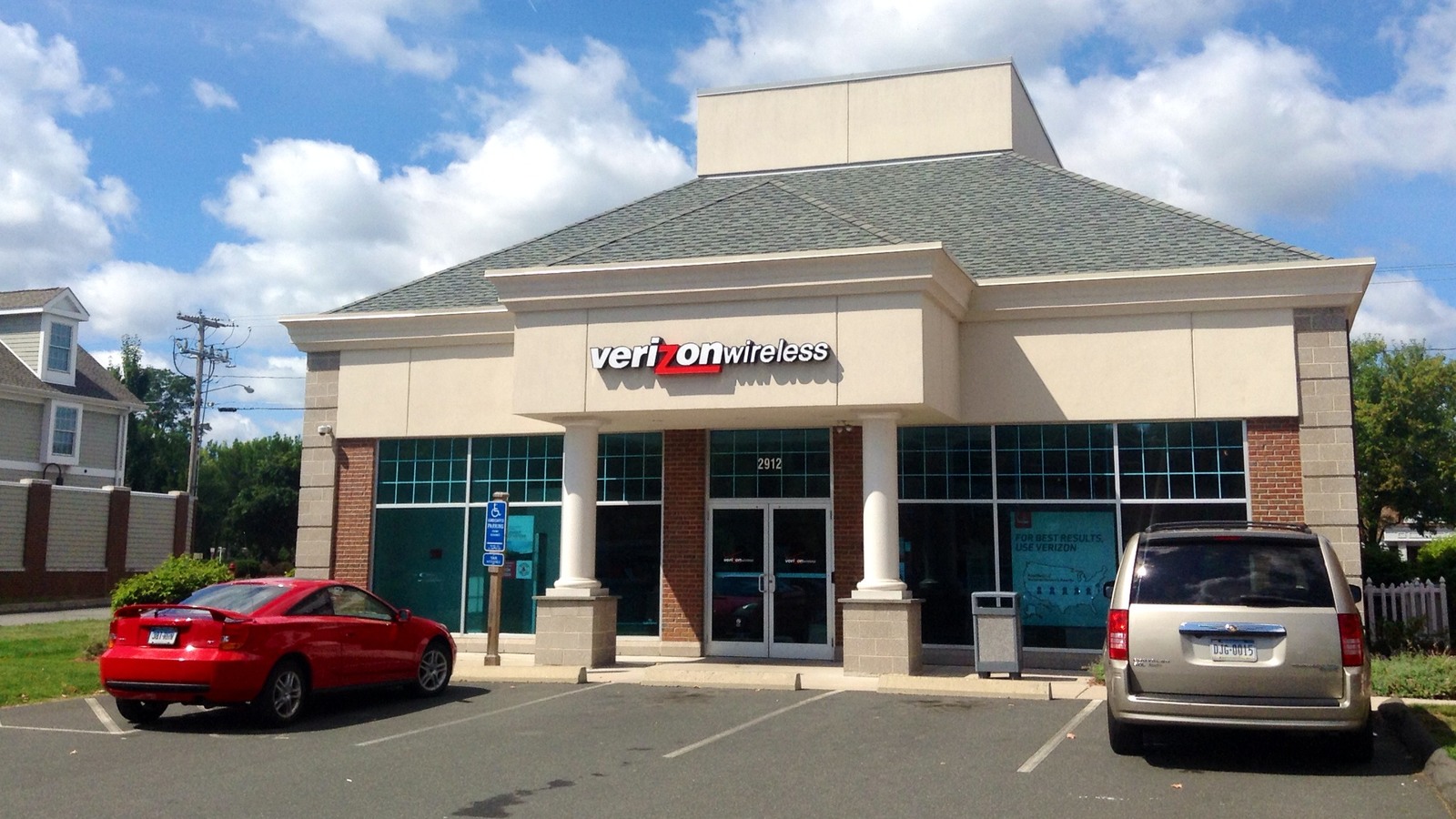
Archival hero: Verizon storefront, Glastonbury, Connecticut, August 2014—not today’s announcement. Photo: Mike Mozart / Wikimedia Commons, CC BY 2.0; cropped and resized.[13][14]
Sources
- [1]Verizon Q3 results and guidance — Verizon · Accessed 2026-10-26T14:27:05.534544-04:00 · Tier 1
- [2]Yahoo VZ daily historical prices — Yahoo Finance · Accessed 2026-10-26T14:27:07.799598-04:00 · Tier 2
- [3]Yahoo VZ historical minute bars — Yahoo Finance · Accessed 2026-10-26T18:18:43.184653+00:00 · Tier 2
- [4]Reuters via CNBC: Verizon forecast and AWS deal — Reuters / CNBC · Accessed 2026-10-26T14:28:28.765049-04:00 · Tier 2
- [5]AT&T Q3 2026 results — AT&T · Accessed 2026-10-26T18:20:47.236639+00:00 · Tier 1
- [6]T-Mobile Q3 reporting schedule — T-Mobile · Accessed 2026-10-26T18:18:06.819465+00:00 · Tier 1
- [7]Federal Reserve October calendar — Federal Reserve · Accessed 2026-10-26T14:27:06.926136-04:00 · Tier 1
- [8]BEA release schedule — Bureau of Economic Analysis · Accessed 2026-10-26T14:27:07.050134-04:00 · Tier 1
- [9]OIC Cash-secured put — Options Industry Council · Accessed 2026-10-26T14:27:06.339982-04:00 · Tier 1
- [10]OIC Covered call — Options Industry Council · Accessed 2026-10-26T14:27:06.604564-04:00 · Tier 1
- [11]OIC The Crush Is Real — Options Industry Council · Accessed 2026-10-26T14:28:28.265029-04:00 · Tier 1
- [12]Fed September 16 statement — Federal Reserve · Accessed 2026-10-26T14:28:28.614208-04:00 · Tier 1
- [13]Mike Mozart photograph and license — Wikimedia Commons / Mike Mozart · Accessed 2026-10-26T14:27:07.496981-04:00 · Tier 1
- [14]Creative Commons BY 2.0 — Creative Commons · Accessed 2026-10-26T14:27:07.655900-04:00 · Tier 1
This content is for informational and educational purposes only and is not financial advice. Options involve risk and are not suitable for every investor. Do your own research before trading.
Keep YieldCove close
Choose YieldCove as a preferred source for Top Stories in Google Search.