Key takeaways
- Caterpillar reported US$20.682 billion of quarterly sales and a US$78.1 billion backlog. [1][2]
- Shares fell 9.30% in a 14:19 ET snapshot despite stronger earnings. [3]
- Moderate fourth-quarter growth and tariff costs complicate the power-generation story. [2]
- A lower share price does not remove a put seller’s assignment risk. [11]
CAT, Oct 29 at 14:19:29 ET
US$647.03
−US$66.35 / −9.30% [3]
Shares traded at snapshot
5,727,590
209.43% of prior-20-day average [3]
Q3 2026 sales and revenues
US$20.682B
+17% year over year [1]
Order backlog, Q3 end
US$78.1B
+US$6.0B from Q2 [2]
Delayed IV / IV rank
39.54% / 39.30%
Page retrieved 14:20 ET [4][5]
What happened: better results, a sharply lower share price
Caterpillar’s October 29 results showed growth across its main machinery businesses, but the stock sold off. Yahoo Finance recorded US$647.03 at 14:19:29 ET, down $66.35, or 9.30%, from the October 28 close of $713.38. This is a dated intraday snapshot, not the closing result or an executable offer. All amounts below are U.S. dollars. [1][3]
The structured snapshot recorded 5,727,590 shares traded. That was 209.43% of the calculated 2,734,895-share average across the preceding 20 completed sessions. Comparing a partial session with full days does not measure time-adjusted unusual activity, but it shows substantial turnover before the close. [3]
For the quarter ended September 30, sales and revenues rose 17% to $20.682 billion from $17.638 billion. GAAP diluted profit reached $7.13 per share, versus $4.88; adjusted, non-GAAP profit was $7.20 versus $4.95. Operating margin improved to 20.4% from 17.3%. These are stronger reported results, not evidence that the share price must rise. [1]
CAT before earnings: 20 completed sessions
October 1–28, 2026; unadjusted closes. October 29 intraday trading is excluded. [3]
Source: Yahoo Finance daily-history endpoint; retrieved October 29, 2026 at 14:19 ET. Completed-session closes rounded to cents. [3]
Why the outlook matters more than the headline
The operating engine was real: Caterpillar attributed revenue growth mainly to $2.2 billion of additional sales volume and $663 million of favorable pricing. Power Generation application sales reached $3.421 billion, up 30%. Management pointed to turbines, related services and large reciprocating engines, primarily in data-center applications. That is a demand signal, not proof that every order is tied to artificial intelligence. [1]
The backlog reached a record $78.1 billion, up $6.0 billion from the second quarter. However, orders are not already-earned revenue. The official presentation maintained its full-year outlook and described fourth-quarter growth as “moderate” versus a year earlier. Investors therefore have to separate a large future workload from the pace at which it becomes sales and cash. [2]
| Measure | Verified figure | Important distinction |
|---|---|---|
| GAAP / adjusted EPS | $7.13 / $7.20 | Adjusted excludes restructuring, not tariff recoveries |
| Power & Energy sales | $8.784B; +18% | Segment total includes intersegment sales |
| Q4 sales outlook | Moderate year-over-year growth | Management forecast, not an achieved result |
| Q4 tariff costs | About $600M | Roughly $200M lower than Q4 2025 |
There is an earnings-quality wrinkle. Operating profit included $128 million of tariff recoveries under the International Emergency Economic Powers Act. The presentation says both GAAP and adjusted EPS benefited by about $0.21. Calling adjusted earnings free of that benefit would be wrong. Meanwhile, the fourth-quarter outlook still includes approximately $600 million of tariff costs, even after the expected year-over-year reduction. [1][2]
A record order book can coexist with a stock-market reset. Orders, margins and expectations are different things. [1][2][3]
Sector and macro: demand is not the same as pricing
This is not simply a story of industrial demand disappearing. Truckmaker PACCAR reported September-quarter revenue of $7.9365 billion on October 27, up 19%, and GAAP diluted EPS of $1.61. Its business mix differs from Caterpillar’s power systems and machinery, so it is context rather than a like-for-like valuation benchmark. Strong sales in a peer do not settle CAT’s margin or delivery questions. [6]
The macro backdrop is mixed rather than uniformly weak. BEA’s October 29 advance estimate put third-quarter real GDP growth at 3.4% annualized, after 2.2% in the second quarter. On October 28, the Federal Reserve held its policy range at 3.75%–4.00%. Growth can support equipment demand while financing costs still matter; neither release proves what caused each dollar of CAT’s decline. [7][8]
What it means for option sellers
Barchart’s page retrieved at 14:20 ET displayed composite implied volatility of 39.54% and IV rank of 39.30%. Its options methodology describes approximately 25–30-minute-delayed analytics. These are a dated publisher snapshot, not live marks or a probability of profit. The rank locates IV within its past-year range; it does not mean a seller has a 39.30% chance of winning. Check live prices before trading. [4][5]
For the wheel, today’s earnings event has happened, but company news and economic surprises can still produce gaps. A cash-secured put exchanges premium for an obligation to buy shares if assigned. A covered call caps the sale price of shares held against it. Neither structure turns a falling industrial stock into a bond, and a premium cannot be evaluated without its strike, expiry, spread and cash obligation. [11][12]
Main risk
A lower entry price is not a floor. Backlog conversion, tariffs and weaker margins can keep pressure on the shares after the earnings headline has passed. Selling premium leaves substantial downside exposure. [1][2][11]
Educational strike math — not a trade idea
For a hypothetical standard 100-share contract, a November 20 $620 put implies $62,000 of purchase cash. At a $580 expiry price, the share-value shortfall is $4,000 before deducting premium received and adding fees. A $680 covered call could require selling 100 shares for $68,000 and caps upside above the strike. These illustrative strikes are not screened recommendations; no premium, liquidity or fill is assumed. [11][12]
- Demand test: distinguish Power Generation sales from the broader segment and total backlog. [1][2]
- Risk test: compare assignment cash with the ability to own the shares through another decline. [11]
- Process test: refresh quotes, spreads and the event calendar; rolling an option does not erase its economic loss. [11][12]
What to watch next
| Date | Event | Why it matters |
|---|---|---|
| November 19, 2026 | CAT dividend payment: $1.63/share | Payment date, not a new entitlement date |
| November 25, 2026, 08:30 ET | BEA second GDP estimate | Revision to today’s advance growth reading |
| December 9, 2026 | Next scheduled FOMC decision day | Rates and financing backdrop |
The dividend’s ex-date and record date were October 26, already past; buying now does not capture that payment. No subsequent earnings date is assumed here. The next useful business evidence is whether orders become deliveries at the promised margins—not whether the stock quickly recovers its prior closing price. [2][10]
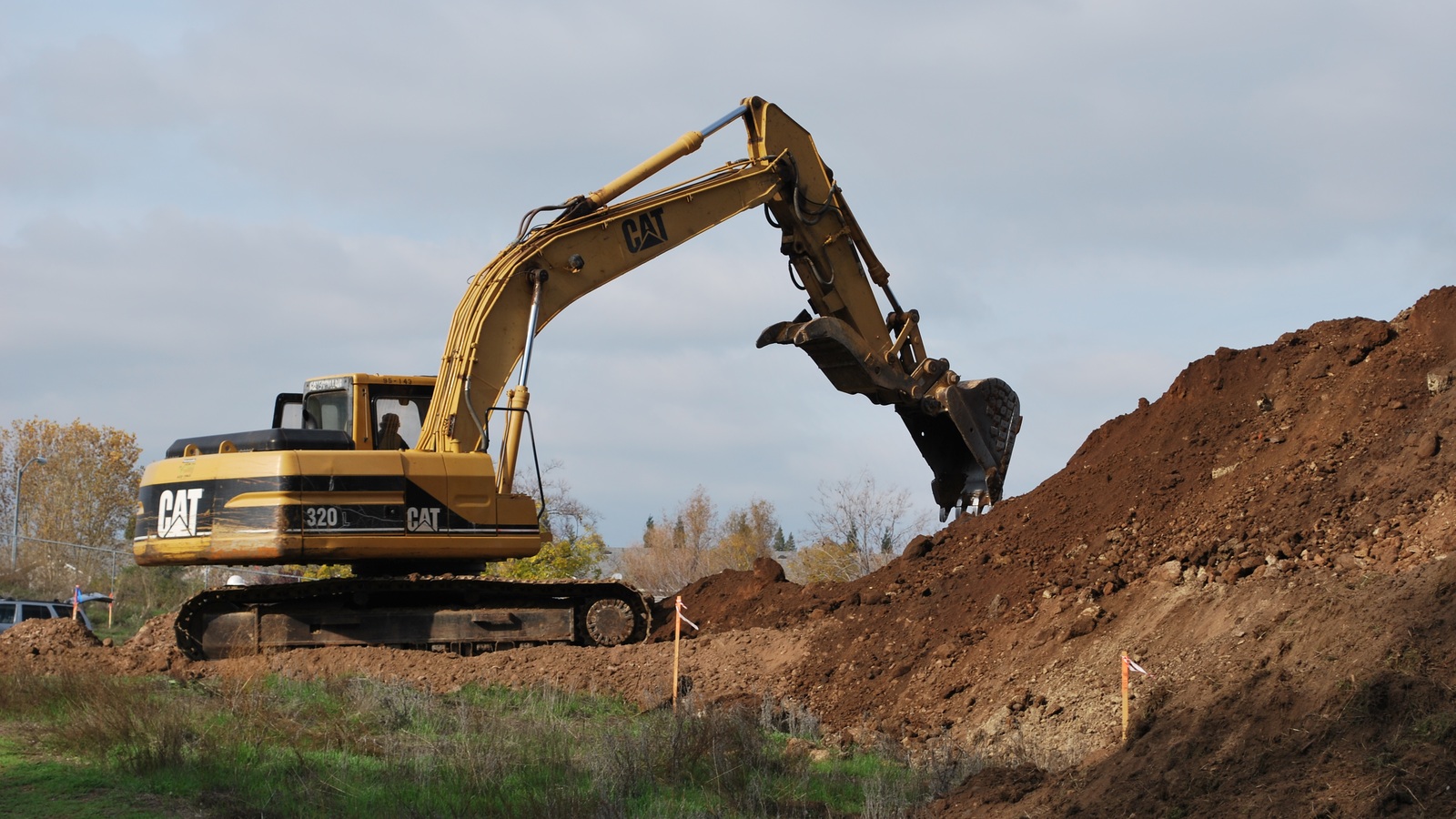
Photo: Justin Smith (J.smith), Wikimedia Commons, archival 2008. Cropped and resized; adapted photograph licensed CC BY-SA 3.0. Equipment illustration, not today’s event. [13][14]
Sources
- [1]Caterpillar Q3 2026 results, including GAAP reconciliation — Caterpillar · Accessed 2026-10-29T14:08:40.271701-04:00 · Tier 1
- [2]Caterpillar Q3 2026 official earnings presentation — Caterpillar · Accessed 2026-10-29T14:09:20.103836-04:00 · Tier 1
- [3]CAT current-session snapshot and daily price/volume history — Yahoo Finance · Accessed 2026-10-29T14:19:32-04:00 · Tier 2
- [4]CAT delayed implied volatility and IV rank overview — Barchart · Accessed 2026-10-29T14:20:35-04:00 · Tier 3
- [5]Option volatility methodology and 25–30-minute delay — Barchart · Accessed 2026-10-29T14:20:35-04:00 · Tier 3
- [6]PACCAR third-quarter 2026 results, October 27 — PACCAR · Accessed 2026-10-29T14:08:40.273195-04:00 · Tier 1
- [7]GDP advance estimate, third quarter 2026 — U.S. Bureau of Economic Analysis · Accessed 2026-10-29T14:19:32-04:00 · Tier 1
- [8]FOMC statement, October 28, 2026 — Federal Reserve · Accessed 2026-10-29T14:19:32-04:00 · Tier 1
- [9]FOMC meeting calendar, 2026 decision dates — Federal Reserve · Accessed 2026-10-29T14:19:50-04:00 · Tier 1
- [10]Caterpillar dividend history and October 2026 declaration — Caterpillar Investor Relations · Accessed 2026-10-29T14:21:48-04:00 · Tier 1
- [11]Cash-secured put: mechanics and risks — Options Industry Council / OCC · Accessed 2026-10-29T14:19:50-04:00 · Tier 1
- [12]Covered call: mechanics and assignment risk — Options Industry Council / OCC · Accessed 2026-10-29T14:21:27-04:00 · Tier 1
- [13]CAT 320 excavator: original photo and author attribution — Wikimedia Commons / Justin Smith · Accessed 2026-10-29T14:13:53-04:00 · Tier 4
- [14]Creative Commons Attribution-ShareAlike 3.0 license — Creative Commons · Accessed 2026-10-29T14:13:53-04:00 · Tier 1
This content is for informational and educational purposes only and is not financial advice. Options involve risk and are not suitable for every investor. Do your own research before trading.
Keep YieldCove close
Choose YieldCove as a preferred source for Top Stories in Google Search.
Run the numbers before you trade: the free wheel strategy calculator sizes the whole cycle, and the cash-secured put calculator shows the cash, return and breakeven of one put.