Key takeaways
- Oracle filed for US$10 billion of stock and later priced US$10 billion of notes on November 2.
- The split matches its October 28 funding plan; it is not an extra US$20 billion above that plan.
- ORCL fell 8.76% in the timestamped end-of-day reference snapshot, underperforming cloud peers.
- Higher implied volatility means more risk to price, not an automatic wheel opportunity.
ORCL • Nov 2, 16:04:26 EST
US$119.22
−US$11.45 / −8.76% vs Oct 30
Volume • same Yahoo snapshot
57,825,126 shares
1.83× preceding 20-session daily average
Financing plan
US$20 billion
US$10bn stock + US$10bn priced notes
Indicative 30-day IV
59.81%
Cboe delayed snapshot; retrieved 16:23 EST
Next U.S. jobs report
Nov 6 • 08:30 ET
The AI funding bill arrives
Oracle advanced its funding plan on Monday, November 2: a proposed US$10 billion stock offering and US$10 billion of priced senior notes. Final note terms were filed at 17:28:31 EST, after the share-price snapshot below. Settlement is scheduled for November 4, not already completed, and neither financing depends on the other closing. Pricing is not proof that Oracle has received the combined US$20 billion. [1,2,17,18]
Shares were sharply lower. Yahoo Finance’s November 2 update timestamped 16:04:26 EST showed US$119.22, down US$11.45, or 8.76%, from Friday’s US$130.67 close. Its reported volume was 57,825,126 shares, versus a 31,682,130-share average over the preceding 20 completed sessions—1.83 times that average. These are frozen reference figures, not live execution prices. [5]
ORCL: 40 sessions into the financing selloff
39 prior-session closes plus the Nov 2 reference at 16:04:26 EST. Unadjusted prices; the last point is the timestamped snapshot. [5]
Source: Yahoo Finance daily chart API [5], retrieved Nov 2, 2026, 16:23 EST; November 2 last reference 16:04:26 EST.
Dilution today, cash-flow promises later
The key distinction is timing. On October 28, Oracle capped additional capital-market funding for its fiscal 2027–2030 investment cycle at US$20 billion, excluding refinancing of existing debt. It expected an even stock/debt split, on top of the US$20 billion equity raise already completed in fiscal Q1. Monday’s filings therefore put the announced plan into motion rather than add another US$20 billion to it. [3]
New stock still spreads ownership across more shares. The prospectus illustrates 76,528,659 new shares at Friday’s US$130.67 price, taking its August 31 base of 3,023,726,695 shares to 3,100,255,354. That is a 2.53% increase in share count, not a guaranteed 2.53% stock-price fall. A lower final sale price would require more shares for the same gross proceeds. [1]
| Instrument / maturity | Principal / stock sought | Coupon / status |
|---|---|---|
| Common stock | US$10 billion | Proposed; final share price unconfirmed |
| Fixed notes • 2029 | US$2.00 billion | 7.000% |
| Fixed notes • 2031 | US$1.75 billion | 7.450% |
| Fixed notes • 2033 | US$2.25 billion | 7.850% |
| Fixed notes • 2037 | US$2.50 billion | 8.000% |
| Fixed notes • 2046 | US$1.50 billion | 8.650% |
The final note structure replaces the preliminary six-series proposal with five fixed-rate series, maturing between 2029 and 2046. Coupons range from 7.000% to 8.650%; these are contractual interest rates, not bond yields. The stated uses of proceeds remain broad—capital spending, debt repayment and other corporate purposes—so treating every dollar as earmarked solely for new AI servers would overstate the disclosures. [1,2,17]
Why this is more than a weak tech session
The peer comparison helps separate the wider market from Oracle’s own financing story. In Yahoo’s November 2 reference updates around 16:00 EST, Microsoft fell 2.83%, Amazon gained 2.20% and QQQ fell 1.36%. Oracle’s much larger decline is consistent with company-specific pressure, although price differences alone cannot prove why every investor sold. [5–8]
The Treasury’s November 2 10-year par yield was 4.91%, down 3 basis points from 4.94% on October 30. That is interest-rate context, not a quote for Oracle’s new bonds; their now-disclosed coupons are separate contractual rates. [16,17]
- Growth is real, but expensive: fiscal Q1 revenue rose 30% to US$19.3 billion, with cloud-infrastructure revenue up 121% to US$7.4 billion. Oracle also reported approximately US$5 billion of negative quarterly free cash flow. [4]
- The near-term promise remains substantial: the October 28 update reaffirmed at least US$90 billion of fiscal 2027 revenue and US$8.10 non-GAAP EPS. Non-GAAP excludes certain expenses and is not interchangeable with GAAP earnings. [3]
- The funding bridge is long: management targets positive free cash flow in fiscal 2028’s second half and at least US$30 billion in fiscal 2029. Those are company forecasts, not cash already earned. [3]
An announced funding limit can reassure investors about the destination while dilution and borrowing costs still weigh on the journey.
What it means for option sellers
Cboe’s delayed snapshot, retrieved at 16:23 EST, showed indicative 30-day implied volatility of 59.81%. A verified IV rank was unavailable, so this figure alone cannot establish that premiums are unusually rich relative to Oracle’s own history. IV measures the movement priced into options, not a forecast of direction or a guarantee that selling premium pays. [9]
For the wheel—selling a cash-secured put, potentially taking shares, then writing covered calls—the important question is the ownership obligation after a gap lower. The next official earnings date was not confirmed in the checked Oracle investor-relations material; an expiry must not be assumed earnings-free. Equity pricing and new filings can also change the picture before the next earnings report. [1,11,12,15,17]
Illustrative math—not a quoted trade
Assume a hypothetical 100-share put at a US$110 strike pays US$2 per share. Gross purchase cash is US$11,000, credit is US$200 and expiry breakeven is US$108 before fees. At a US$100 expiry stock price, the net loss is US$800; at zero it is US$10,800. A hypothetical US$130 covered call caps the share sale price at that strike if assigned but does not create a floor under the stock. Neither strike nor premium is a recommendation or a current quote. [11,12]
A bigger premium is not a safety cushion
A financing-related gap can overwhelm collected premium, and assignment can leave a put seller owning a falling stock. A covered call retains substantial stock downside. Fees reduce net results; tax treatment depends on the account and jurisdiction. [11,12]
What to watch next
- November 4: scheduled note settlement, not a completed closing. Watch the final equity sale price, actual shares issued and closing confirmations; the checked stock prospectus remains preliminary. [1,17]
- November 3, 10:00 ET: September JOLTS; November 6, 08:30 ET: October employment. Rate expectations can matter to a business funding a large investment cycle. [10]
- November 10, 08:30 ET: October CPI. Separately, the next earnings update must test whether revenue growth and spending are moving toward management’s fiscal-year targets. [3,10,15]
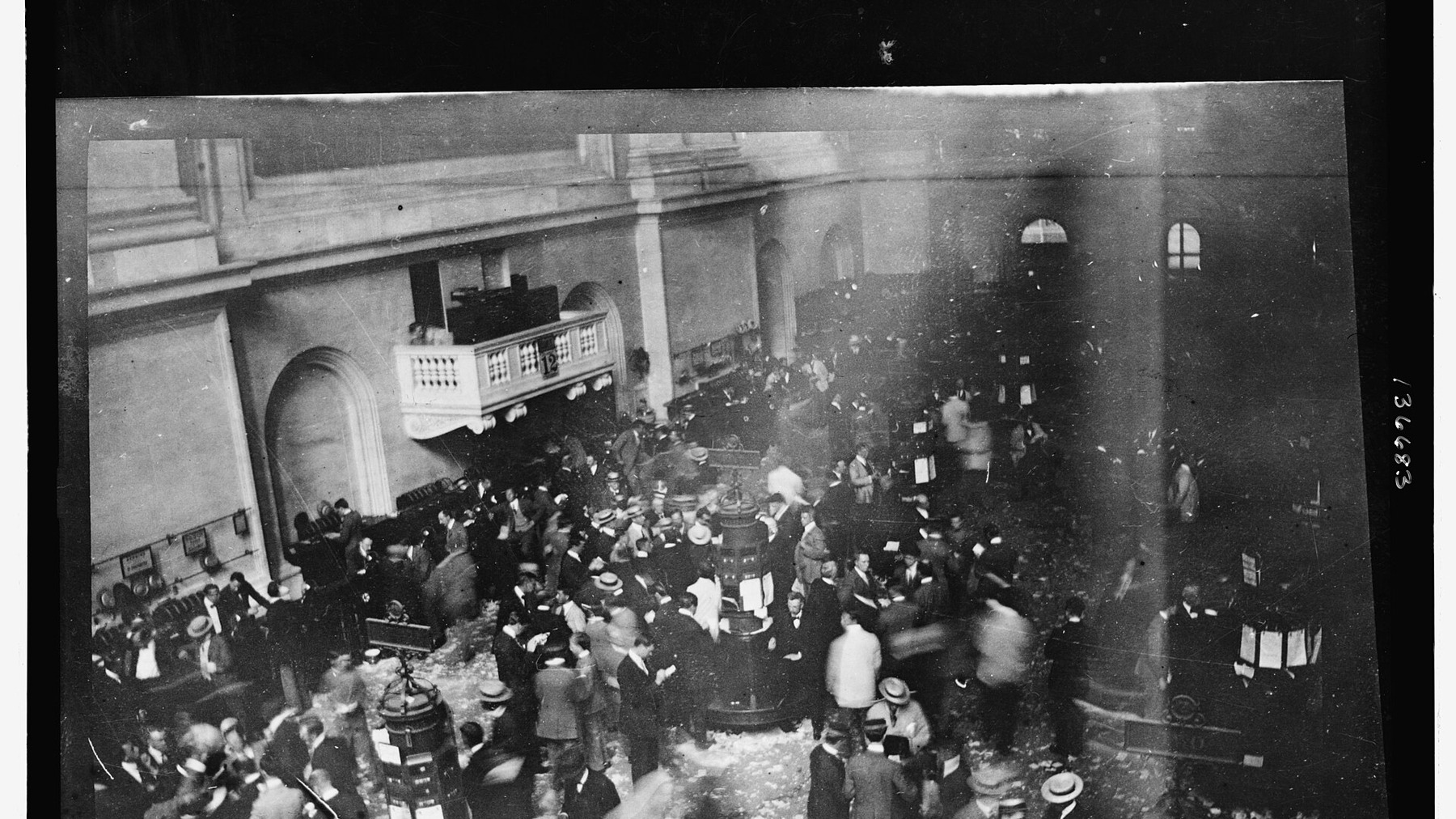
Photo: the New York Stock Exchange floor in 1907, not Oracle’s current financing event. Library of Congress / Wikimedia Commons; cropped archival photograph, public domain. [13,14]
Sources
- [1]November 2 preliminary US$10bn common-stock prospectus — Oracle / SEC EDGAR · Accessed 2026-11-02T16:23:22.854885-05:00 · Tier 1
- [2]November 2 preliminary US$10bn senior-notes prospectus — Oracle / SEC EDGAR · Accessed 2026-11-02T16:23:55.687604-05:00 · Tier 1
- [3]October 28 Investor Day: funding limit and financial outlook — Oracle Investor Relations · Accessed 2026-11-02T16:23:22.855336-05:00 · Tier 1
- [4]September 10 fiscal Q1 2027 results and Q2 outlook — Oracle Investor Relations · Accessed 2026-11-02T16:23:22.855791-05:00 · Tier 1
- [5]ORCL November 2 reference quote and daily history — Yahoo Finance · Accessed 2026-11-02T16:23:22.857251-05:00 · Tier 2
- [6]MSFT November 2 reference quote — Yahoo Finance · Accessed 2026-11-02T16:23:23.115130-05:00 · Tier 2
- [7]AMZN November 2 reference quote — Yahoo Finance · Accessed 2026-11-02T16:23:23.010805-05:00 · Tier 2
- [8]QQQ November 2 reference quote — Yahoo Finance · Accessed 2026-11-02T16:23:23.136477-05:00 · Tier 2
- [9]ORCL delayed snapshot: indicative 30-day implied volatility — Cboe Global Markets · Accessed 2026-11-02T16:23:22.856958-05:00 · Tier 1
- [10]Official November 2026 economic release calendar — U.S. Bureau of Labor Statistics · Accessed 2026-11-02T16:23:22.856080-05:00 · Tier 1
- [11]Cash-secured put: mechanics, maximum loss and assignment — Options Industry Council / OCC · Accessed 2026-11-02T16:23:23.140182-05:00 · Tier 1
- [12]Covered call: capped upside and stock downside — Options Industry Council / OCC · Accessed 2026-11-02T16:23:23.297162-05:00 · Tier 1
- [13]Archival photograph: New York Stock Exchange floor, 1907 — Library of Congress / Wikimedia Commons · Accessed 2026-11-02T16:37:24.117000-05:00 · Tier 1
- [14]Public Domain Mark 1.0: rights explanation — Creative Commons · Accessed 2026-11-02T16:39:37.139834-05:00 · Tier 1
- [15]Oracle events and presentations: earnings-date check — Oracle Investor Relations · Accessed 2026-11-02T16:23:23.325178-05:00 · Tier 1
- [16]November 2 official daily Treasury par yield curve — U.S. Department of the Treasury · Accessed 2026-11-02T16:43:06.682174-05:00 · Tier 1
- [17]November 2 final note-pricing term sheet: five fixed-rate series — Oracle / SEC EDGAR · Accessed 2026-11-02T17:38:59.201837-05:00 · Tier 1
- [18]Oracle SEC filing index: November 2 acceptance timestamps — SEC EDGAR · Accessed 2026-11-02T17:38:59.336225-05:00 · Tier 1
This content is for informational and educational purposes only and is not financial advice. Options involve risk and are not suitable for every investor. Do your own research before trading.
Keep YieldCove close
Choose YieldCove as a preferred source for Top Stories in Google Search.
Run the numbers before you trade: the free wheel strategy calculator sizes the whole cycle, and the cash-secured put calculator shows the cash, return and breakeven of one put.